
If you’re a scalper trading in and out of positions within minutes, every tick matters. Many traders start with Simple Moving Averages (SMAs)—only to later discover Exponential Moving Averages (EMAs) might feel “closer to real-time.” So, which is better for scalping: SMA or EMA?
This article breaks down the difference, shares real trader experiences, and gives practical setups you can apply to your charts today.
What Are Moving Averages and Why Do Scalpers Use Them?
At their core, moving averages (MAs) smooth out price data. They’re designed to reduce noise and help traders identify the general direction of the market.
- SMA (Simple Moving Average): Averages all closing prices equally.
- EMA (Exponential Moving Average): Gives more weight to recent prices, making it more responsive.
For scalpers, the attraction is obvious: a good moving average can serve as a roadmap, helping to confirm entries and exits. But not all MAs are created equal.
How SMA Works in Scalping
The SMA is like the “classic” version of a moving average. Every data point in the chosen period is weighted equally.
Advantages of SMA
- Smoother and less reactive to short-term noise.
- Better for identifying longer-term trends.
- Commonly used by institutions (e.g., 50-day SMA known as the “institutional line”).
Disadvantages of SMA
- Too slow for scalpers.
- It can cause missed entries in fast markets.
- Reacts late to sudden reversals.
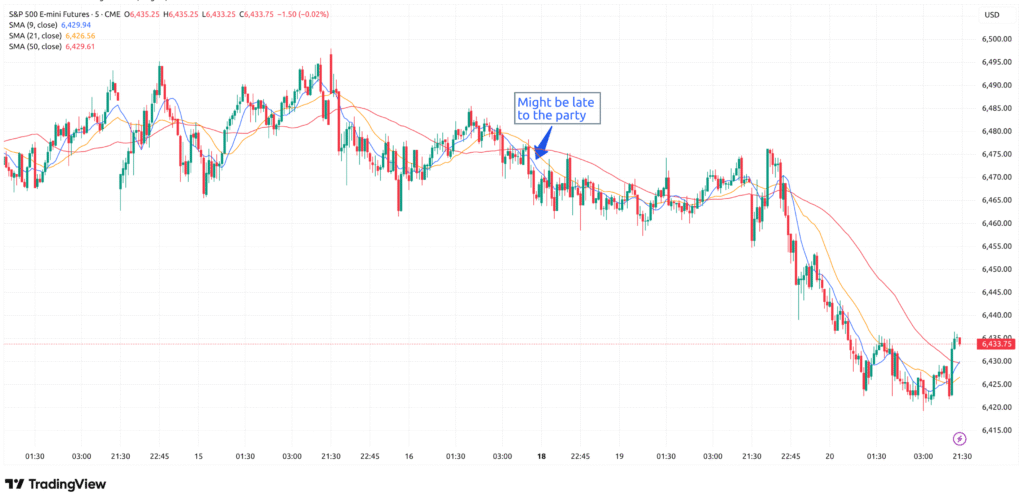
Example: A scalper using SMA(9, 21, 50) on a 5-minute chart may find that by the time price “confirms” above an SMA, the move is already halfway done.
How EMA Works in Scalping
The EMA weights recent prices more heavily, which makes it more agile.
Advantages of EMA
- Faster reaction to recent moves.
- Captures momentum better in short timeframes.
- Popular with intraday traders and scalpers.
Disadvantages of EMA
- Too sensitive in choppy markets.
- Can generate false signals (whipsaws).
- Requires discipline to avoid overtrading.
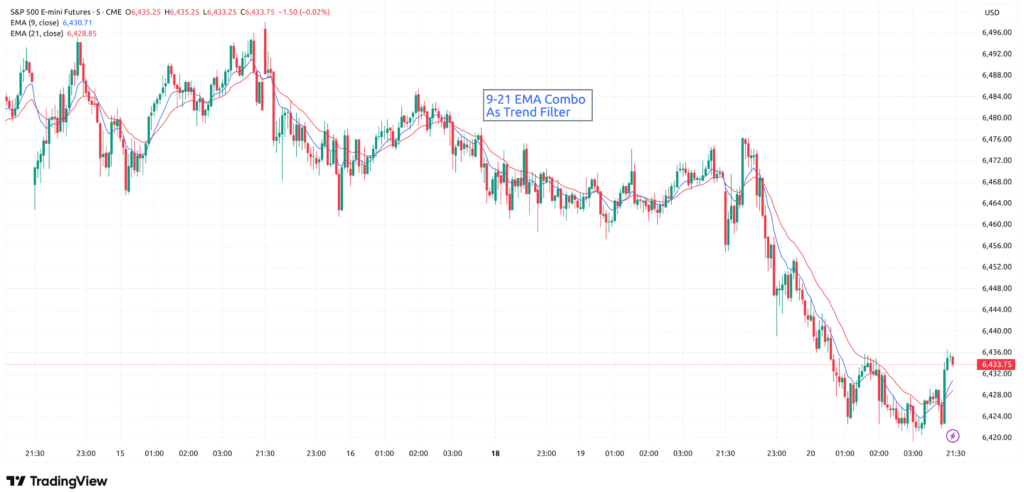
Example: Many scalpers swear by the 9 EMA and 21 EMA combo on the 5-min chart. A wick rejection off the 9 EMA in a strong trend often signals continuation.
Real Trader Perspectives
- EMA for Scalpers: Many day traders rely on EMA because it adapts faster to intraday price shifts. A 9 EMA / 21 EMA crossover is one of the most cited intraday signals.
- SMA for Higher Timeframes: Swing and institutional traders still respect the 50 SMA and 200 SMA as strong support/resistance lines. Even intraday, these levels often act as magnets.
- Combining Both: Some traders use EMA for entries and SMA for overall trend context. For example, a 5 EMA vs 9 SMA crossover can help spot short bursts of momentum.
- Price Action First: Several pros argue that indicators should never replace price action, VWAP, and volume. They use moving averages only as confirmation, not as the main trigger.
SMA vs EMA: Key Differences for Scalpers
| Feature | SMA | EMA |
|---|---|---|
| Weighting | Equal across all periods | Heavier on recent data |
| Speed | Slower, smoother | Faster, more reactive |
| Best Use | Long-term trends, swing trades | Short-term trends, scalping |
| Reliability | Fewer false signals | More false signals in choppy markets |
| Pro Usage | 50/200 SMA = institutional levels | 9/21 EMA = intraday scalping setups |
Practical Scalping Setups
1. EMA-Only Setup (Fast Momentum Scalps)
- Chart: 1-min or 5-min
- Indicators: 9 EMA + 21 EMA
- Strategy: Enter on pullbacks where candles wick off the 9 EMA, stop above candle high, exit at first higher high or EMA cross.
2. SMA-EMA Combo (Balanced)
- Chart: 5-min
- Indicators: 5 EMA + 9 SMA
- Strategy: Look for early crossovers for entry signals, confirm direction with 50 SMA as trend filter.
3. SMA Trend Filter + EMA Entry (Hybrid)
- Chart: 15-min / 1-hr for trend, 5-min for entry
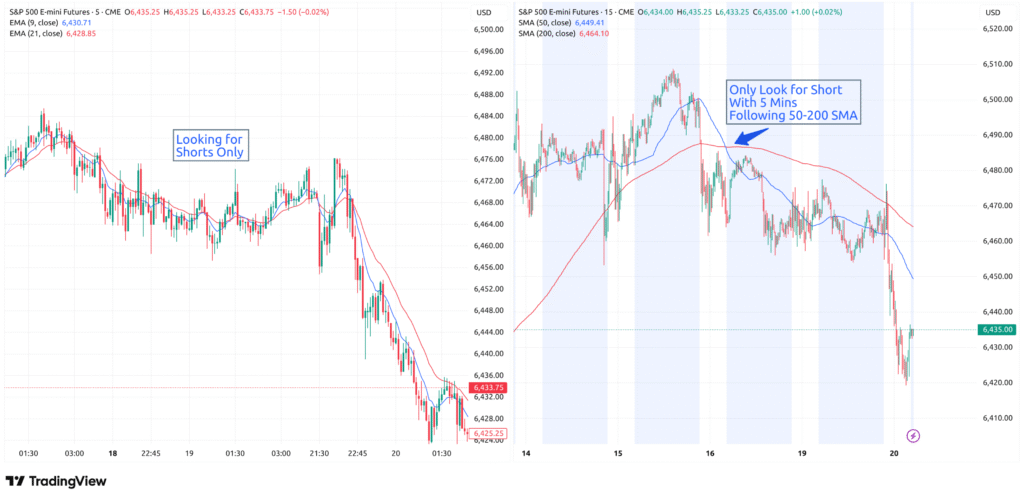
- Indicators: 50/200 SMA on higher timeframe + 9/21 EMA on 5-min
- Strategy: Only scalp in the direction of the SMA trend, time entries using EMA pullbacks.
Institutional Use: What the Pros Do
- In the 1990s–2000s, Wall Street traders commonly used 5, 20, 50, and 200 SMAs on daily charts. The 50 SMA was sometimes called the “institutional line.”
- Modern intraday pros often combine VWAP + EMA (9/21).
- Some use quarterly/yearly averages like 63 EMA (quarter) and 252 EMA (year).
- Key lesson: institutions respect longer SMAs but often trade entries on short EMAs.
Advantages & Disadvantages in Scalping
EMA Pros
✅ Quicker response to market moves
✅ Great for short-term signals
✅ Works well with VWAP & intraday PA
EMA Cons
❌ Too sensitive in sideways markets
❌ Higher false breakouts
❌ Requires strict stop-losses
SMA Pros
✅ Stronger trend confirmation
✅ Widely watched by institutions
✅ Acts as reliable S/R on higher TF
SMA Cons
❌ Too slow for scalpers
❌ Late entries in volatile moves
❌ Not responsive enough intraday
Final Takeaways
- Scalpers: EMA is generally more useful (e.g., 9/21 EMA on 5-min).
- Swing Traders / Position Traders: SMA (50, 100, 200) holds stronger weight.
- Hybrid Approach: EMA for entries + SMA for trend bias offers the best of both worlds.
- Professional Insight: No single MA is magic. Most pros use price action + VWAP + maybe 1–2 moving averages max.
FAQ
Q: Which is better for scalping, SMA or EMA?
A: EMA, because it reacts faster to recent price action.
Q: Do pros use moving averages?
A: Yes, but usually alongside VWAP and price action. Many keep charts clean.
Q: Can I combine SMA and EMA?
A: Yes, combining them can highlight both short-term momentum and long-term trend strength.
Q: What’s the best EMA for scalpers?
A: Popular combos are 9 EMA and 21 EMA on the 5-minute chart.
Remember, indicators won’t save you if you ignore risk management strategies.
Even the best indicator setup—EMA, SMA, or VWAP—will fail if you don’t manage position size, stop-losses, and risk per trade. Successful scalpers focus less on finding the “perfect indicator” and more on combining technical tools with strict money management and managing their stress to protect capital.


