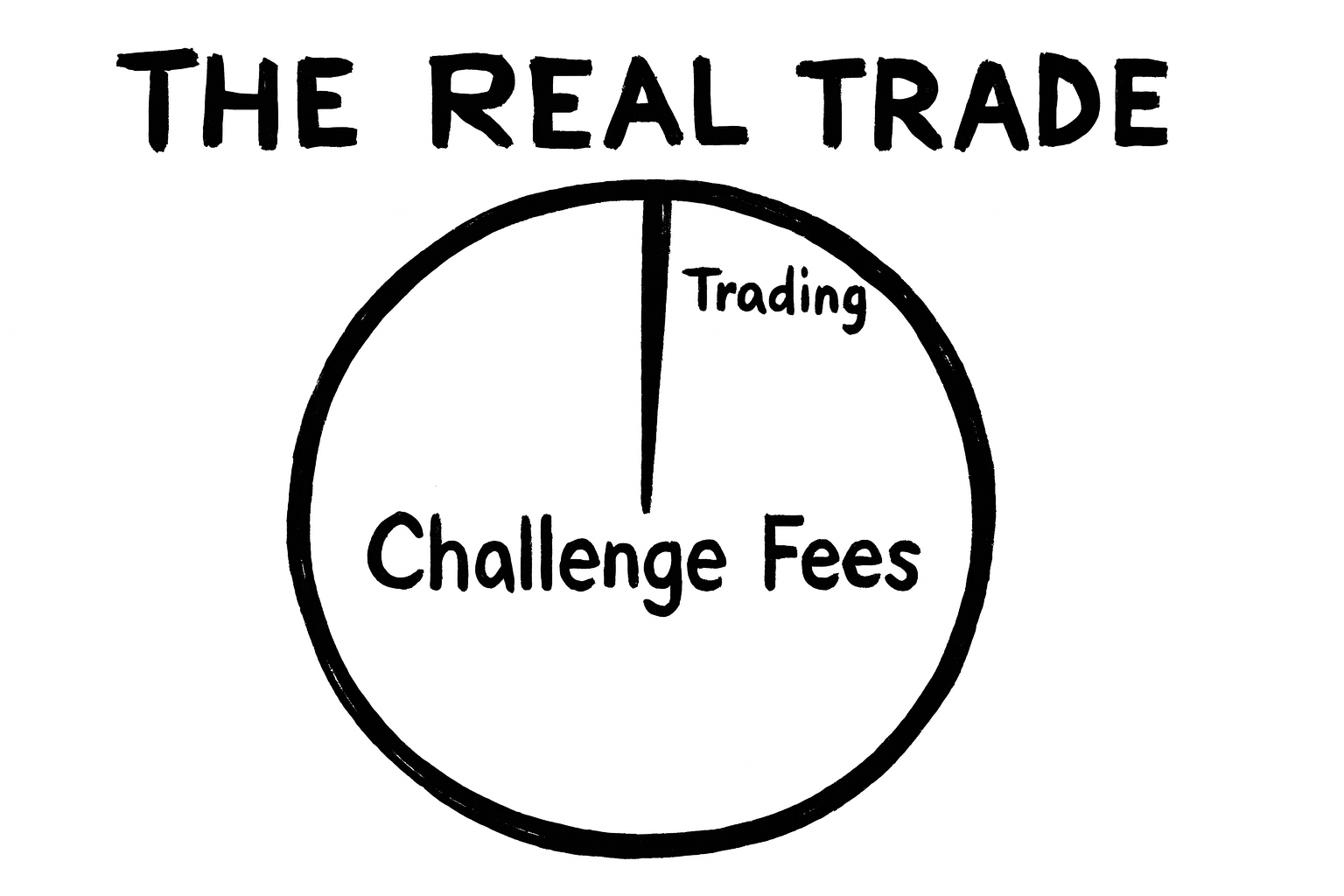
Spoiler: Prop firms don’t get rich trading the markets.
They get rich trading traders.
Their business model isn’t about market direction — it’s about monetising trader psychology at scale.
But here’s the paradox: once you understand how the house wins, you can use that same structure to win for yourself.
🧮 The Core Equation
Let’s run the real math.
Example Scenario
- 1,000 traders each buy a $200 challenge
- Revenue = $200,000
Assume 5% reach payout phase:
- 50 traders × $1,000 payout = $50,000
- Add platform and admin costs ≈ $10,000
- Net profit ≈ $140,000 before overhead
That’s 70% gross margin — and the firm doesn’t need to touch a live market position to earn it.
🧩 The Four Real Revenue Streams
1. Challenge Fees (The Engine – 85% to 90% of Revenue)
Every failed challenge is pure margin.
There’s no capital at risk, no market exposure — just simulated data running on servers.
The firm’s model is built on volume, not victory.
They know 9 out of 10 traders fail because the rules are mathematically tilted toward emotional breakdowns.
2. Reactivation & Reset Fees (The Psychology Tax – 5% to 10%)
This is the slot-machine lever of the prop world.
You’re down –$2,450 on a –$2,500 drawdown.
A email appears:
“Reactivate your account for just $75 instead of starting over for $200!”
You click.
You’ve just been monetised for your regret.
Reactivation revenue is the perfect behavioural loop — the illusion of progress keeps traders spending.
3. Subscriptions & Add-Ons (The Long Tail – 2% to 5%)
Monthly “account maintenance,” platform access, add-on dashboards — tiny per user, massive in aggregate.
Some firms even sell internal analytics or affiliate commissions to influencers.
These layers create recurring, zero-risk income streams.
4. Hedging Profitable Traders (The Illusion of Market Risk – 0% to 5%)
A handful of top-tier firms — actually hedge or mirror their most consistent traders.
But this isn’t the Wall Street version of “prop trading.”
Here’s how it really works:
- When your account shows consistent profitability, the firm may replicate your trades in its own live book.
- They’re not “backing you” with capital — they’re arbitrageur your skill.
- Each mirrored trade earns them pennies on the spread or slippage, rather than significant directional bets.
It’s scalable, but only across a handful of consistently profitable traders — maybe 1 in 100
The real money still comes from the other 99 who failed the evaluations.
📈 Why This Model Prints Money
- Infinite Attempts — Each failure incurs an additional $150–$300 ticket.
- Fixed Cost, Variable Revenue — Same servers, more traders, linear profit.
- No Market Risk — ES can rally or collapse; its revenue curve doesn’t flinch.
- Human Behaviour Is Predictable — Impulsivity, FOMO, and greed pay the bills.
It’s a self-funding loop powered by emotion, not execution.
🧠 Behavioural Economics at Work
Prop firms don’t need to manipulate charts — the rule design does the filtering:
- Daily drawdowns punish impatience.
- Profit targets trigger over-sizing.
- Time limits create urgency.
- Consistency rules reward monotony (and punish luck).
It’s a casino where every rule is statistically optimised to expose your weakest psychological habit.
The losers pay for the infrastructure that lets the 5% of disciplined traders collect payouts — and those winners become the firm’s best marketing.
⚙️ Why Smart Traders Still Use Them
Knowing the system is rigged doesn’t make it worthless.
It makes it predictable.
1. Capital Leverage for Cheap
$150 for access to $50K of simulated capital = 333:1 leverage on your own money.
No broker offers that without some margin risk.
2. Forced Discipline
Rules you should follow anyway — max daily loss, controlled risk — are enforced by termination.
That external structure is worth paying for if you struggle with self-control.
3. Scalable Income Without Big Deposits
You can’t turn $1K into $10K/month on a retail account without blowing up.
Prop firms let you scale across multiple funded accounts safely.
4. Risk Transfer
Once you’ve pulled your first payout, you’re free-rolling.
Future profits = upside. Failures result in a reset fee, not a margin call.
They carry the operational risk; you carry the behavioural one.
🔍 The So What
Understanding the business model changes how you approach it.
When you know how they make money, you can structure your behaviour to avoid being their revenue source.
Stop thinking like a trader taking a test.
Start thinking like a player optimizing a system.
🎯 What to Do Now — Tactical Plays
Here’s how to use the house rules to your advantage:
- Demo the Rulebook First
- Trade the exact prop ruleset (profit target, drawdown, daily loss) on a free broker demo for 30 days.
- If you can’t pass your own test, you’ll fail theirs.
- This costs $0 and saves $200+ per mistake.
- Buy One Account, Not Ten
- More accounts = split focus = faster failure.
- Treat one challenge like an evaluation for a job — total commitment.
- Stack Small Wins, Not Resets
- Stop rebuying the same account to “get back.”
- Pass one account → withdraw → fund another firm.
- Diversify payouts, not resets.
- Track Behavior, Not P&L
- Journal rule violations, not trade results.
- Your edge isn’t the setup — it’s consistency under constraints.
- Think Like a Quant, Not a Gambler
- Run your own math: risk %, drawdown buffer, expected value.
- The firm profits from averages; you profit by staying outside them.
🪞 Final Thought
Prop firms are not evil.
They’re machines built to monetize impatience — and they’re transparent about it.
Your job isn’t to fight the machine.
It’s to learn its parameters and operate inside them like a professional.
The house always wins — unless you stop playing their game and start running your own.
🔗 Related Reading
👉 Prop Trading Firms Explained: A Trader’s Honest Guide
👉 Why You’re Failing Prop Challenges (It’s Not Your Strategy)