Bottom Line Up Front:
Prop firms sell you access to trading capital for a fee. They’re not scams—but they’re not charities either.
Think of them as skill-based lotteries: the house has an edge through its rules, but unlike gambling, your skill and discipline genuinely improve your odds.
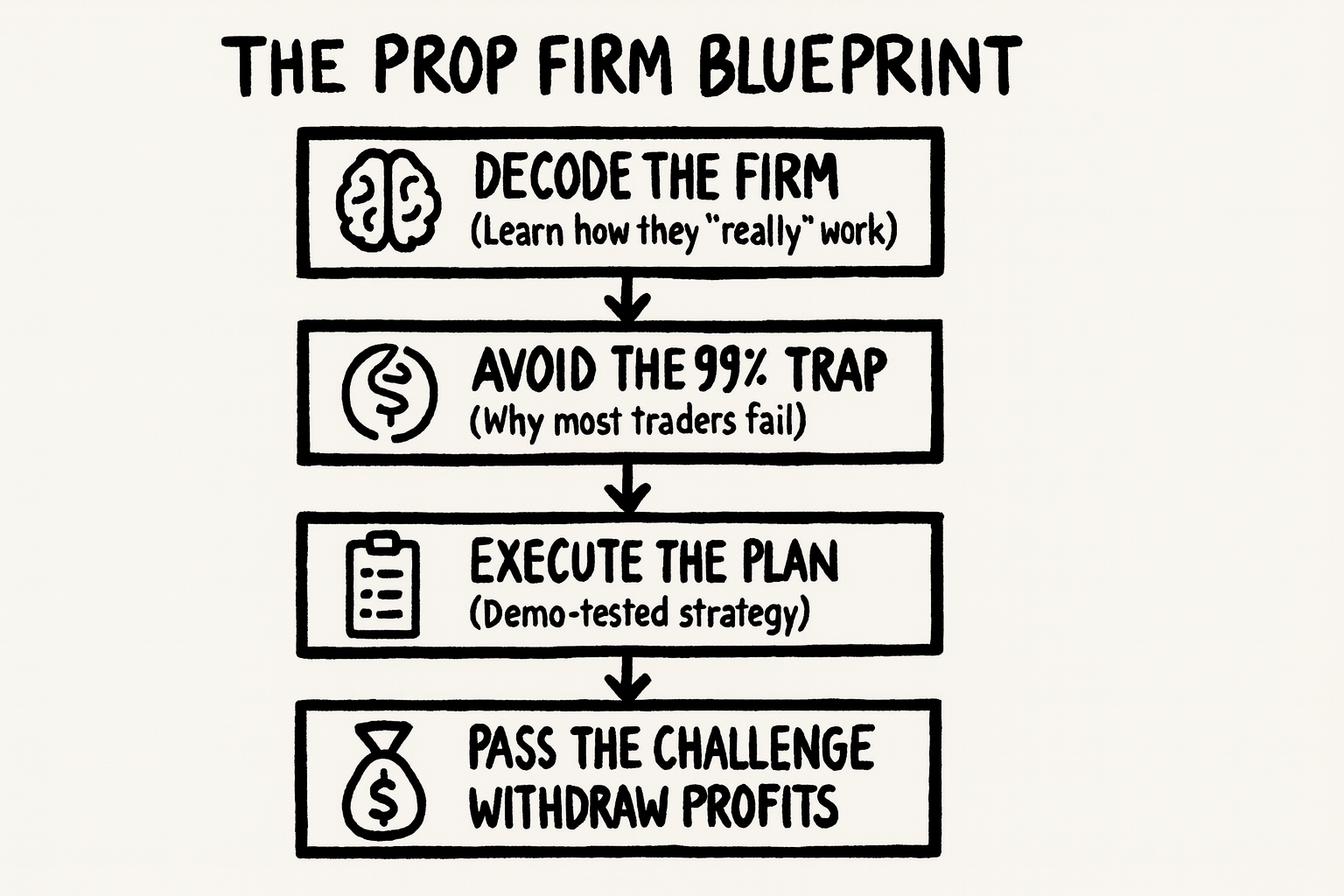
This guide breaks down exactly how the prop firm model works, why most traders fail, and how to be among the few who actually withdraw profits instead of chasing challenges.
🧩 Part 1: What You’re Actually Buying
When you pay $100–$500 for a prop firm challenge, you’re not buying trading capital.
You’re buying a performance test—a simulated environment where you prove that you can manage risk, follow rules, and stay disciplined.
Here’s what you really get:
- A simulation, not access to real exchange capital.
- A rulebook, designed to test discipline under pressure.
- Temporary leverage, if you pass.
- A mirror, reflecting how you handle fear and greed.
Your P&L exists inside their servers, not on the CME or your broker’s clearinghouse.
Once you understand that, you stop expecting “funded” to mean “trading real money” right away.
💰 Part 2: How Prop Firms Actually Make Money
Let’s be blunt. Prop firms are not in the business of creating traders—they’re in the business of monetising trader psychology.
Revenue Breakdown:
- 85–90%: Failed challenge fees
- 5–10%: Reactivation/reset fees
- 2–5%: Subscriptions, platform costs
- <5%: Real trading profits
If 1,000 traders each buy a $200 challenge, that’s $200,000 in revenue. Maybe 5% pass and the firm pays out $10,000–$15,000.
They don’t need to “cheat.” The rules do the filtering.
- Tight daily drawdowns force emotional trading.
- Profit targets trigger overtrading.
- Time limits create FOMO.
- Consistency rules punish randomness.
The result?
99% of traders fail, yet the firm remains profitable without ever touching live markets.
💻 Part 3: Sim vs. Live Trading — Does It Matter?
Most prop firms run on simulated feeds. That’s not always bad.
For limit order traders:
- ✅ Fills match real market prints.
- ✅ Charts mirror live data.
- ✅ Tight spreads, no slippage.
For market order traders or scalpers:
- ⚠️ Slippage and latency differences matter.
- ⚠️ Execution under volatility can vary.
- ⚠️ Spread behaviour differs during news.
But here’s the truth:
If you can’t make money on a sim account with perfect fills, you won’t make it live under worse conditions.
Props are tests of discipline, not execution. If your edge can’t survive ideal conditions, it won’t survive real ones.
🧠 Part 4: The Psychology Behind Prop Firm Rules
Prop firms have studied human behaviour as deeply as casinos.
They profit from our impulses—not our trades.
Here’s how they win:
- “I’m so close” syndrome → pay for a reset.
- Account stacking → scattered focus.
- Rushing to meet targets → low-quality trades.
- Revenge trading → buying new accounts.
Yet behind the manipulation lie good trading principles:
- 5% max total drawdown
- 2.5% daily max loss
- 1–2% risk per trade
- Consistency over chaos
If you can’t pass these “rigged” tests, you won’t last in real trading.
🏆 Part 5: Who Actually Wins (And Why Most Don’t)
Roughly 1% of traders ever reach consistent payouts.
Winners:
- Already profitable on small personal accounts
- Treat prop firms as leverage, not lottery tickets
- Risk 1–2% per trade
- Pass on the first or second attempt
- Withdraw early and diversify
Losers:
- Buy 10+ cheap accounts during sales
- Over-leverage to “hit the target”
- Blow up, blame the system, repeat
A trader with $300–600 can realistically control $50k–$100k of capital if they focus on one challenge, one rulebook, one method.
🧾 Part 6: How to Choose the Right Firm
Green Flags:
- Consistent payout track record
- Clear about sim vs. live funding
- Transparent rulebook
- Responsive support
Red Flags:
- Constant 90% “limited-time” sales
- Changing rules mid-challenge
- Long payout delays
- New firms (<18 months old) with flashy ads
Ask these before buying:
- What % of traders pass?
- Is funding live or simulated?
- What’s your average payout delay?
- Can you show recent payouts?
- How do you handle disputes?
If they dodge those, walk away.
📅 Part 7: The Funded Trader Battle Plan
Phase 1: Demo First
- Open a free demo on a real broker.
- Trade with prop-style rules for 30–60 days.
- Journal everything.
Phase 2: First Challenge
- Buy ONE account.
- Trade exactly like your demo.
- Review emotional triggers daily.
Phase 3: First Payout
- Withdraw the minimum to prove legitimacy.
- Use 10% of the payout to test a second firm.
- Keep the rest as a buffer or personal seed fund.
Phase 4: Scale Wisely
- 2–3 firms max.
- Withdraw monthly.
- Funnel 50% of profits into your own broker account.
⚖️ Part 8: The Psychology of Staying Funded
Prop trading isn’t just technical—it’s emotional.
Common traps:
- Revenge trading after a loss
- Target fixation (forcing trades to hit goals)
- Overconfidence after a win
You win long-term by doing boring, repeatable things daily:
- Pre-market review: “What went right, what went wrong?”
- Post-trade journaling: rate setups & emotions
- Weekly reflection: identify emotional patterns
Discipline is the real alpha.
📊 Part 9: Realistic Results and ROI
| Trader Type | Time to Payout | Monthly Net Income | ROI | Outcome |
|---|---|---|---|---|
| Top 10% | 3–6 months | $8k–15k | 10,000%+ | Runs it like a business |
| Top 25% | 6–12 months | $4k–8k | 4,000%+ | Refines strategy |
| Serious 50% | 12–24 months | $2k–5k | 1,000–5,000% | Slow compounding |
| Rest 75% | Never | $0 | — | Emotional burnout |
The math isn’t hype. It’s behavioural reality.
⚙️ Part 10: The Hard Truth
Prop firms aren’t scams.
They’re businesses that monetize trader behavior—and they work because most traders lack consistency.
Truth #1: Prop firms exploit psychology.
Truth #2: Disciplined traders can still beat the game.
You decide which truth defines your outcome.
🎯 Part 11: What To Do Next
- Prove yourself on a free demo for 60–90 days.
- Buy one challenge from a reputable firm.
- Trade your plan—no shortcuts, no revenge trades.
- Withdraw early, document everything.
- Diversify across firms.
- Build your own capital base.
🧭 Part 12: The Bottom Line
Prop firms are mirrors, not miracles.
They don’t make you disciplined—they expose whether you are.
For gamblers, prop firms are expensive lessons.
For professionals, they’re the cheapest leverage on earth.
The edge isn’t in the firm. It’s in your behaviour.
👋 Final Thought
Don’t buy ten accounts during a sale.
Buy one, master one rulebook, and treat it like your apprenticeship.
The opportunity is real.
The odds are not.
Your edge is discipline. Your enemy is emotion.