💡 What You’re Actually Buying in a Prop Firm Challenge
Spoiler: You’re not buying trading capital — you’re buying a psychological test.
And understanding this will save you thousands.
🧩 The Big Misunderstanding
Every trader who pays $100–$500 for a prop firm challenge imagines they’re “buying access to capital.”
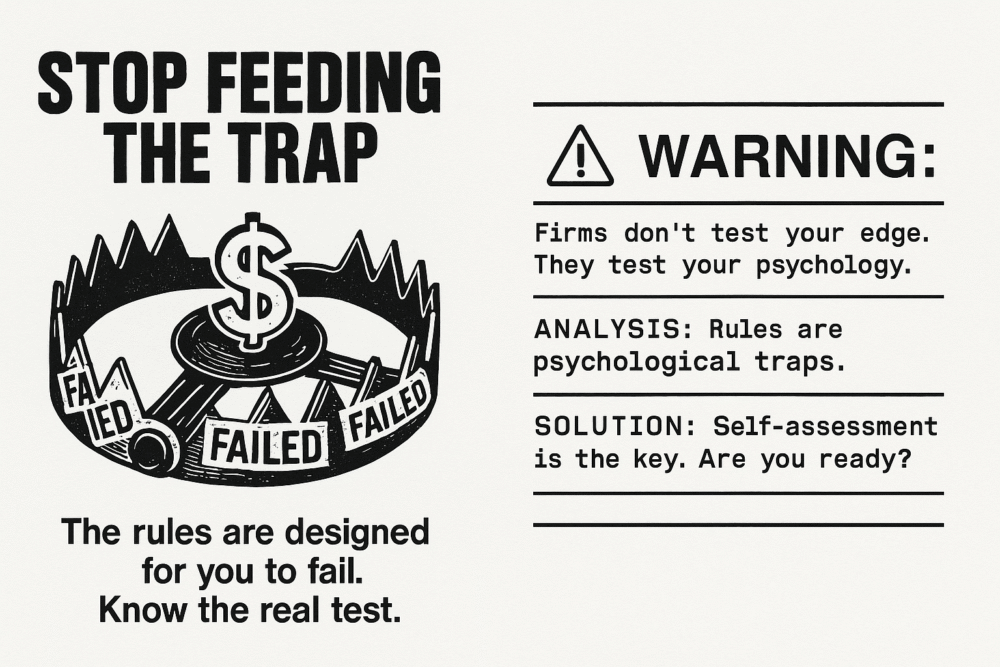
But here’s the truth: you’re buying a psychological exam — a stress test designed to measure your emotional control under pressure.
Once you grasp that distinction, everything changes.
Stop treating prop challenges like lottery tickets.
🎯 What You’re Really Buying: A Psychological Test
Prop firms don’t give you money — they give you a sandbox.
Your challenge is to survive long enough in that sandbox without breaking any rules.
You’re being tested on four psychological dimensions that decide 99% of outcomes.
⚖️ 1. Drawdown Management
Test: Can you stop trading when you’re halfway to your limit?
- ❌ Most traders: “I’m down $1,200 of $2,500 — I can still make it back.”
- ✅ Winners: Stop at 60%, cut size, and live to fight another day.
🎯 2. Target Detachment
Test: Can you trade without chasing the profit goal?
- ❌ Most traders: “Only $1,000 left to target — time to force trades.”
- ✅ Winners: Trade A+ setups only, hit goals naturally across 40–60 trades.
🚫 3. Rule Adherence
Test: Can you stop trading at your daily loss limit — even when you “know” the next trade will win?
- ❌ “Just one more trade.” → Violate by $50 → Instant fail.
- ✅ Winners: Stop at 80% of daily loss, close charts, journal the day.
🔄 4. Variance Tolerance
Test: Can you handle five straight losses without system-hopping?
- ❌ “This strategy doesn’t work anymore.”
- ✅ Winners: Trust 100-trade data sets, not emotional reactions.
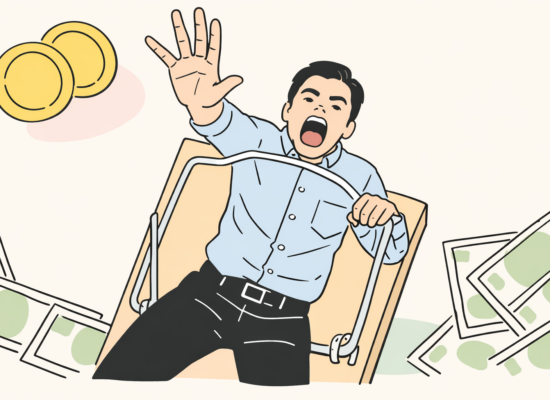
These four tests aren’t random. They’re deliberately engineered psychological traps — and if you understand them, you can exploit them instead of getting eliminated by them.
🧠 The Psychology Behind the Rules
Prop firms don’t need to cheat — they just design rules that favour the house over infinite trials, exactly like casinos.
It’s not a trading test. It’s a behavioural filter.
📉 How the Rules Create Predictable Failure
Typical $50K challenge setup:
- $2,500 total drawdown (5%)
- $1,250 daily drawdown (2.5%)
- $5,000 profit target
- 30 days
Now compare two traders:
| Risk per trade | Trades to pass | Consecutive losses to fail | Probability of blowing up |
|---|---|---|---|
| 2% ($50) | 100+ | 25 | 0.0003% |
| 10% ($250) | 20 | 5 | 3.1% |
The math exposes the trap:
- Profit targets create greed → oversized risk
- Drawdowns punish greed → instant fail
- Time limits amplify urgency → FOMO and revenge trades
It’s psychological warfare disguised as trading.
💬 The Hidden Emotional Triggers
Every rule is designed to prey on a trader’s emotions:
| Rule Type | Emotion It Triggers |
|---|---|
| Daily drawdown | Fear → hesitation or revenge trading |
| Profit target | Greed → over-leverage |
| Time limit | FOMO → poor setups |
| Consistency rule | Ego → overtrading to prove skill |
The firm profits from your predictable reactions.
Once you master that awareness, you start trading like a professional instead of a participant in their behavioural experiment.
🧾 Sim vs Live: The Reality You Don’t See
Most “funded accounts” are still simulated — trades exist only in the firm’s database.
Demo Stage (Sim)
- Trades mirror live prices, but orders aren’t routed to exchanges.
- You enjoy perks that disappear in live trading:
✅ Zero slippage
✅ Instant fills
✅ No partial fills
✅ Stable spreads
When It Matters
- Swing traders: 95% identical between sim and live.
- Scalpers: Critical difference. 1–2 ticks of slippage = $500–$1,000 weekly swing.
- Market order traders: Sim gives false precision — real fills are worse.
💡 If your system collapses under 2–3 ticks of slippage, it’s not robust enough for live capital.
🏦 Live Stage: When (and If) You Reach It
Most firms use internal hedging — your “live” trades are mirrored or offset.
Only a handful ever offer proper direct market access, and that’s reserved for top-tier, consistent traders with months of verified performance.
Estimated odds based on industry data:
Less than 5% of challenge passers ever reach true live capital.
Less than 1% of all buyers get there.
✈️ Think of It Like Flight School
You don’t start flying passengers.
You begin by learning to handle turbulence, failure, and stress in a simulator.
A prop firm faces the same challenge.
They want to see how you handle:
- Being down $1,200 (fear)
- Being one trade from target (greed)
- Missing an entry (FOMO)
- Five straight losses (variance)
They collect data about your behaviour, not the market.
💰 The Business Model: Why It Works
The retail prop firm model is mathematically genius.
| Metric | Traditional Prop Shop | Retail Prop Firm |
|---|---|---|
| Trader capital risk | Firm’s real money | Zero (sim) |
| Scaling | Limited by capital | Infinite (software) |
| Profit source | Trader’s real P&L | Challenge fees |
Example:
1,000 traders × $200 fee = $200,000
5% pass → 50 traders
Avg payout = $2,000 → $100,000 total payout
Firm profit: $100,000 — with zero market risk.
It’s not unethical — it’s efficient.
They profit from your behaviour; you can profit by mastering it.
🎓 Why Smart Traders Still Use Prop Firms
Knowing the game doesn’t mean avoiding it — it means playing it strategically.
💡 Smart Traders Use Props For:
- Leverage — $150 for $50K buying power (333:1) (Use this when there’s a once-in-a-blue-moon exceptional event)
- Forced discipline — rules enforce accountability
- Scalable income — pass multiple firms, compound returns
- Risk transfer — once funded, you trade house money
The Smart Flow:
- Pass small challenges first
- Withdraw profits early
- Reinvest 50% into your own brokerage
- Build personal capital while scaling funded accounts
By Year 3 → $50K personal + $150K prop = $200K combined capital base.
Low risk, high flexibility.
🧭 The Takeaway
You’re not buying capital — you’re buying a mirror that reflects your trading psychology.
The mirror shows whether you can:
- Follow rules under pressure
- Detach from targets
- Handle variance without panic
- Trade with discipline, not emotion
Pass the test, and you earn leverage.
Fail, and you get tuition — not tragedy.
🔥 The Question That Changes Everything
Most traders ask:
“Is the capital real?”
But the real question is:
“Am I real under pressure?”
The capital becomes real when you prove you can handle it.
Until then, the simulation protects both you and the firm from emotional damage.
✅ Quick Self-Assessment: Are You Ready?
Before buying any challenge, ask yourself:
- Can I trade profitably on demo for 60+ days?
- Can I stop trading when I reach 80% of my daily loss?
- Can I stick to 1–2% risk per trade?
- Can I handle 5 consecutive losses calmly?
- Can I ignore profit targets and trade only my edge?
If you answered “no” to any of these, you’re not ready.
Fix the behaviour first. Then pay for the test.
🪞 Final Thought
Prop firms don’t fail you.
You fail yourself — and they built a business around that statistical certainty.
Your job isn’t to beat the system.
Your job is to be the exception.
Trade with rule-based discipline, not emotion.
That’s how you pass prop challenges — and more importantly, how you survive the markets long-term.