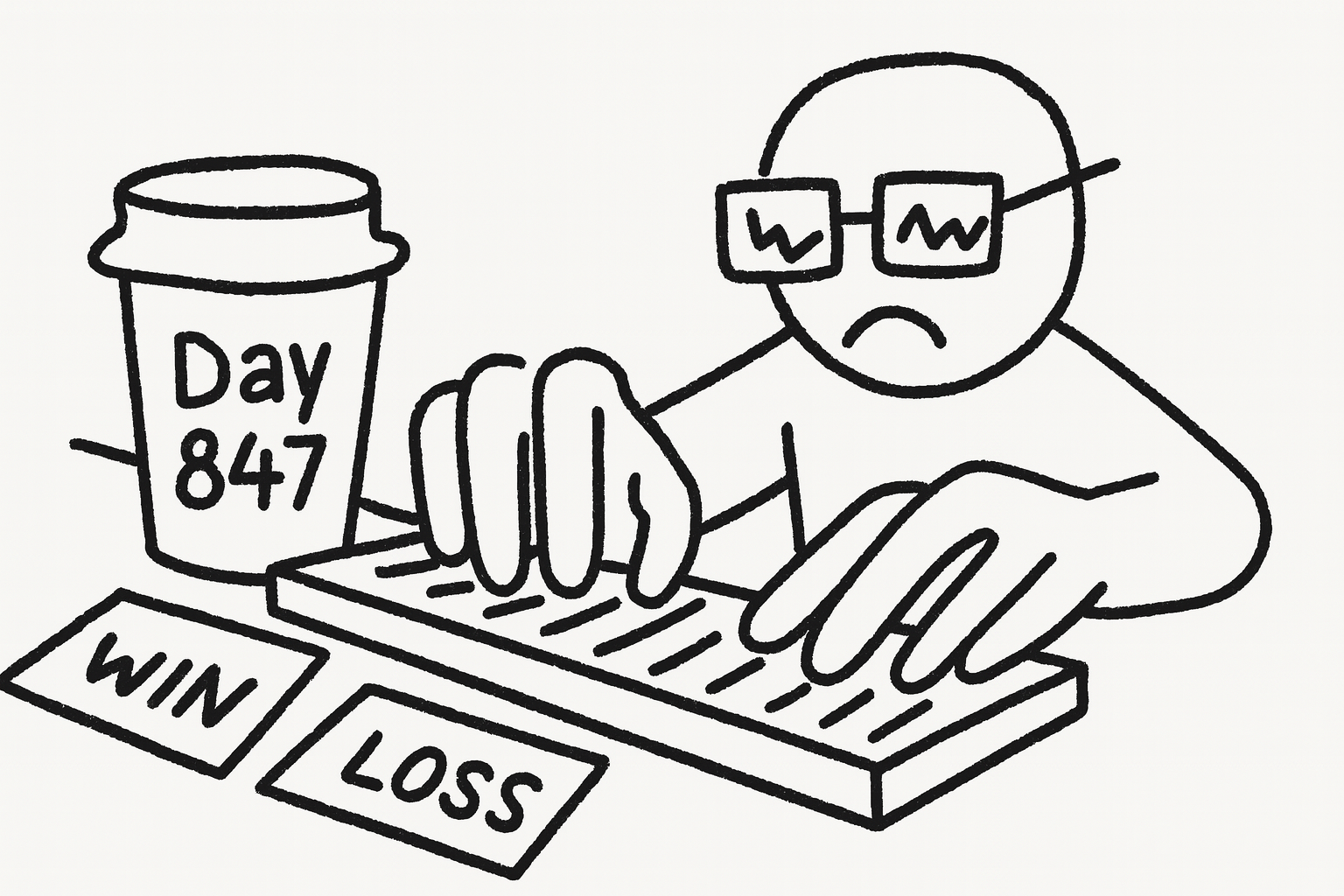
The media have been loud in warning against day trading.
The headlines say the same thing over and over:
- It’s gambling in disguise.
- Almost nobody makes a living from it.
- Those who do succeed work harder than 9-5 employees.
- The idea of freedom? A fantasy.
One article profiled a Danish woman who has traded for 15 years. Her daily routine? Six screens, endless hours, and the admission that it’s “way harder than a normal job” with none of the freedom outsiders imagine.
The underlying message: stay in your lane, keep the 9-5, and don’t chase this dream.
Why I Took Notice
After twenty years as a software engineering manager, I know what corporate grind feels like—budgets, politics, layoffs, endless reorgs, and pager duty at midnight. I’ve led good teams, but I’ve also lived on the treadmill.
So when the media dismisses trading outright, I want to cut through the noise. Is it really all gambling, or just another brutally hard career path?
The Reality: Harder Than a 9-5
Let’s be clear: comparing day trading vs 9-5 isn’t fair. Trading is harder.
- The failure rates are brutal: most retail traders lose money (Commodity Futures Trading Commission).
- The learning curve is long: expect 3–5 years of consistent daily study before seeing reliable profits. Many need longer.
- The psychological toll is real: Financial stress can trigger anxiety and depression (APA). I’ve seen it wreck marriages, trigger anxiety disorders, and crush confidence. The isolation can be devastating for people used to team environments.
If you’re looking for an easy escape, this isn’t it.
Styles of Trading: Not Everyone Uses Six Screens
Yes, some traders run six monitors for ten hours a day. But not all. Others trade the open for an hour, set alerts on their phones, and move on. Swing traders may hold positions for days or weeks.
But don’t mistake longer timeframes for “easier.” Swing trading carries the same emotional battles—fear, overconfidence, and revenge trading—just stretched across days instead of minutes.
The Freedom Myth
Freedom is the most dangerous illusion for beginners.
- Real freedom only comes from consistency.
- Until then, the market becomes your boss—unforgiving, unpredictable, and relentless.
- Losing streaks can last months, eroding not just your finances but your identity.
Trading is not an escape from work. It’s a different kind of prison, and only a few learn to live comfortably inside it.
The Capital & Tax Reality
Two non-negotiables most newcomers underestimate:
- Capital Requirements
To generate a living wage, you need serious capital. Many professionals recommend a minimum of $100,000–$ 150,000. Anything less forces you into dangerous leverage. (Investopedia on day trading capital requirements). - Brutal Taxes
For example, a 42% capital gains tax in Denmark is a nearly insurmountable handicap for active traders. Even top 5% performers globally would struggle to net a meaningful income after taxes and living costs.
Together, these factors mean trading in places like Denmark is not just difficult—it’s almost mathematically impossible for most people.
Market Regime Shifts
A hidden danger: what works today won’t necessarily work tomorrow. Strategies built in bull markets collapse in sideways chop or bear markets. Adapting to new volatility regimes takes years of experience. Few traders master this.
My Decision
I’ve spent decades in corporate life. I know the hamster wheel. Trading tempts me not as a shortcut, but as a new challenge.
Here’s my grounded transition plan:
- Keep my day job initially to cover income needs.
- Trade small size for at least 2 years—expecting nothing more than tuition. Risk management is key.
- Save 2–3 years’ worth of living expenses before considering trading full-time for a living.
- Focus more on swing trading to balance screen time and learning pace.
- Accept that this may never replace salary income—and plan accordingly.
This isn’t a romantic escape. It’s an experiment in building skill, with a Plan B ready in case it fails.
The Social & Psychological Costs
What most people never talk about:
- Trading is incredibly isolating. No teams, no colleagues, no validation. Just you versus the market.
- The mental health toll is heavier than most 9-5 jobs: depression, burnout, self-doubt.
- Without support systems, it’s easy to spiral.
Adjusting to this solitude may be harder than learning technical setups.
If you’re exploring this, also read: trading psychology and mindset.
Regulatory Risks
Unlike a traditional career, trading comes with rules that change overnight. New regulations, broker restrictions, or technological changes can kill strategies that once worked. This is an extra layer of uncertainty that few beginners anticipate.
The Hard Truth
Day trading is not freedom.
It’s not glamorous.
It’s not guaranteed.
It’s a grind, a fight, and for most, a losing battle.
If you still choose to pursue it, do so with:
- Capital you can afford to lose.
- Years of patience before expecting returns.
- Mental preparation for isolation and self-doubt.
- A Plan B when the math doesn’t work out.
For some, the payoff is control over their time and finances. For most, it’s an expensive lesson in humility.
Final Thoughts
Comparing day trading vs 9-5 isn’t about easy vs hard. It’s about two kinds of hard.
The corporate world can grind you down with its politics, bosses, and schedules. Trading grinds you down with losses, isolation, and self-doubt.
Neither is freedom by default. But both can be survivable if approached with discipline.
The question isn’t “Can I escape the 9-5?”
It’s: “Am I prepared to fight a different, harsher battle—one where the odds are stacked even higher against me?”
Frequently Asked Questions (FAQ)
1. Is day trading harder than a 9-5 job?
Yes. When comparing day trading to a 9-to-5 job, trading is mentally and emotionally more demanding. Corporate jobs bring steady paychecks and predictability. Day trading demands constant decision-making, emotional discipline, and resilience through losing streaks. Most people underestimate the psychological pressure until it breaks them.
2. How long does it take to become profitable as a trader?
Typically, 3–5 years of consistent daily study and practice. Some take even longer. Trading isn’t a weekend skill—it’s more like earning another degree. During this time, most traders lose money, which is why the failure rate is so high.
3. Can you really make a living from day trading?
It’s possible but rare. To generate a full-time income, you usually need $100K–$150K in trading capital and a proven strategy. Even then, many traders fail because they can’t manage risk or adapt to changing markets. Without enough capital, you’re forced into dangerous leverage that usually ends in losses.
4. What are the psychological costs of day trading?
Severe. Trading can lead to:
- Anxiety and depression from repeated losses.
- Isolation compared to corporate team environments.
- Marital and family stress, especially during long losing streaks.
The mental health toll is often worse than a 9-5 job, and most people are unprepared for it.
5. Do trading strategies work in all market conditions?
No. Strategies that work in bull markets often fail in bear markets or sideways chop. Successful traders learn to adapt to different market regimes and volatility environments. This adaptation can take years and is one reason consistency is so rare.
6. How do taxes affect day trading?
For example, Denmark’s 42% capital gains tax makes trading almost mathematically impossible for most people. Even with loss offsets, your strategy must perform at elite levels to break even after taxes and living expenses. For many, this tax environment alone makes full-time day trading unrealistic.
7. Is swing trading easier than day trading?
Not necessarily. Swing trading reduces screen time, but the psychological battles remain the same—fear, greed, and impatience—just stretched out over days or weeks instead of minutes. Many assume it’s easier, but it still requires discipline, risk management, and years of practice.
8. Is day trading realistic at age 50?
It’s possible, but the time horizon works against you. At 50, you often need income now, not in 3–5 years after learning curves have been overcome. The added challenge is learning new technology platforms, market structures, and tools that are constantly evolving. For many, swing trading or part-time trading while maintaining a job is a more realistic option.
9. What is the role of survivorship bias in trading success stories?
It’s massive. You’ll hear about the handful of traders who succeed but rarely about the thousands who blow up accounts and quit. Survivorship bias makes day trading myths vs reality hard to separate, especially in online communities where failure stories go silent.
10. Should I have a Plan B if I pursue trading?
Absolutely. Statistically, most traders fail. A Plan B could mean keeping your day job, building other income streams, or setting strict financial limits. Without one, trading can quickly destroy both finances and confidence.


