I’ve been trading moving averages for over six years now, and if there’s one question I’ve asked myself more than once, it’s this: Are EMAs still effective in 2025?
For me, the answer so far has been yes. My trading toolbox has always included the 20, 50, 100, and 200 exponential moving averages (EMAs). I don’t use them as magic buy/sell triggers but as confirmation tools for entries. And the numbers back it up: over the past three years, I’ve maintained a win rate of around 68% using EMAs as part of my trading strategy.
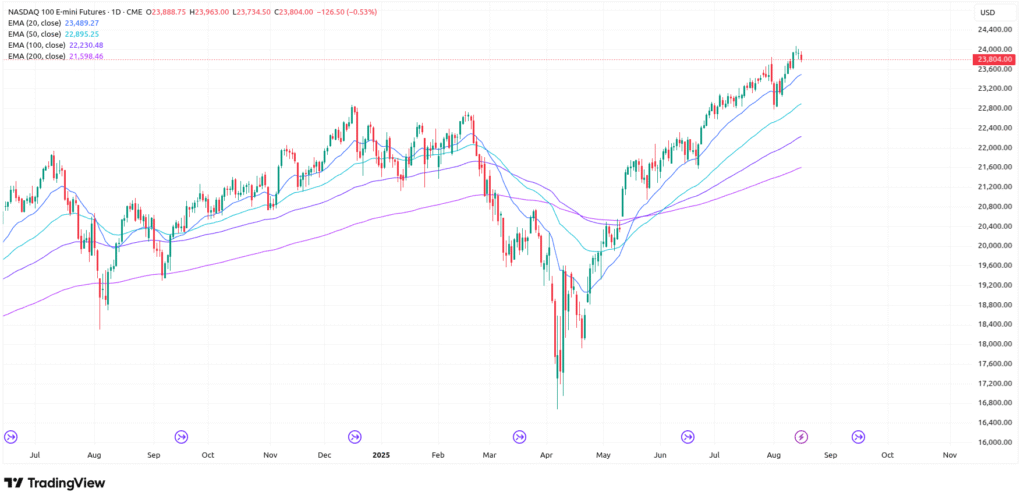
But here’s the catch—across trading forums, YouTube, and social media, I keep hearing that EMAs are “too obvious,” “lagging,” or that smart money hunts retail traders who rely on them. Which made me stop and ask: should I adapt, or trust what works?
Why Traders Still Believe EMAs Are Effective
Plenty of traders argue that EMAs remain one of the most reliable trading tools available. The reasoning is simple:
- All tools are lagging. As one trader put it, candlesticks, order flow, and even ICT concepts are built on historical data. EMAs just make that history clearer.
- Trend confirmation. Many use a single EMA to stay on the right side of the market and avoid overthinking.
- Statistical edge. One trader mentioned EMAs added about 5% to their win rate—small but significant over hundreds of trades.
- Dynamic support/resistance. Long-term EMAs (like the 200 EMA on a 4H chart) are widely respected, even by institutions.
- Multi-timeframe confirmation. Some combine shorter EMAs (5 or 20) with longer ones to gauge momentum and reversals.
In short, the math hasn’t changed. If price respects a level, traders will act on it—and that action makes EMAs effective.
The Criticism: Are EMAs Really an Edge?
Of course, not everyone agrees. The main critiques against EMAs go like this:
- They lag too much. By the time an EMA cross signals a breakout, much of the move may already be gone.
- Backtesting results are mixed. One trader who coded multiple EMA trading strategies over 10 years claimed they “always break even.”
- They aren’t an edge by themselves. An EMA line doesn’t guarantee profits. It needs to be combined with risk management, context, and other confirmations.
- Alternatives exist. Many traders now prefer tools like VWAP, anchored VWAP (AVWAP), Bollinger Bands, or pure price action to reduce lag and incorporate volume.
The bottom line? An EMA is a tool, not a strategy. On its own, it won’t make you profitable.
My Answer: Are EMAs Still Effective?
For me, the proof is in the results. With a 68% win rate across three years, EMAs clearly still play a role in my edge. They:
- Keep me disciplined in trend-following.
- Help filter out bad trades.
- Provide structure when markets get noisy.
But I also don’t treat them as gospel. Risk management, trade expectancy, and psychology matter more than whether the line slopes up or down.
The traders who succeed with EMAs usually:
- Backtest their EMA trading strategy instead of relying on theory.
- Use EMAs as confirmation, not signals.
- Blend them with price action, support/resistance, or volume tools.
Final Thoughts: Should You Still Trust EMAs?
So, are EMAs still effective?
Yes—if you know how to use them.
They’re not magic. They’re not predictors. But they’re still one of the simplest ways to understand trend direction, momentum, and areas where traders might step in.
If you’re debating whether to include them in your trading:
- Test them. See how they perform on your timeframe and market.
- Adapt them. Don’t use them blindly—combine with context.
- Make it yours. The real edge isn’t the EMA itself; it’s how you apply it.
After six years, EMAs remain part of my edge—and until the stats tell me otherwise, I’ll keep riding this train.
FAQ: Are EMAs Still Effective in 2025?
1. Are EMAs still effective in 2025?
Yes. Exponential moving averages (EMAs) remain effective when used correctly. They aren’t a magic signal, but they still help traders identify trend direction, momentum shifts, and dynamic support/resistance levels. Their effectiveness depends on how you combine them with risk management, price action, and other confirmations.
2. Do moving averages still work in day trading?
Moving averages—including EMAs—are still widely used in day trading. Many scalpers and intraday traders rely on the 9 EMA and 20 EMA for fast momentum setups. Others prefer the 50 EMA or 200 EMA on higher timeframes to align with the bigger trend. The key is to test them within your strategy rather than copying and pasting settings.
3. Is the EMA crossover strategy still profitable?
The classic EMA crossover (e.g., EMA 50 crossing EMA 200 = golden cross) can still be profitable in trending markets. However, it tends to lag and often produces false signals in choppy, sideways conditions. Most profitable traders today use crossovers as part of a larger system, paired with support/resistance, VWAP, or volume profile, to filter out bad trades.
4. What’s the difference between EMA and SMA in trading?
- EMA (Exponential Moving Average): Gives more weight to recent prices, allowing it to react faster to market moves.
- SMA (Simple Moving Average): Averages all prices equally over a period, making it slower but smoother.
If you’re a momentum trader, EMAs are usually better. If you prefer a cleaner long-term view, SMAs may be a better fit for you.
5. How effective are exponential moving averages compared to VWAP?
VWAP (Volume-Weighted Average Price) incorporates both price and volume, providing traders with insight into where the “average” participant is positioned. Many argue it’s more reliable than EMAs alone. That said, EMAs are still effective as a price-based guide, while VWAP can act as a volume-weighted confirmation tool. Some traders combine both for stronger setups.
6. What are the best EMA settings for trading in 2025?
There’s no one-size-fits-all, but here are the most common:
- Short-term momentum: EMA 9 and EMA 21
- Medium-term confirmation: EMA 20 and EMA 50
- Long-term trend: EMA 100 and EMA 200
Ultimately, the “best” EMA depends on your timeframe, market, and style (scalping, swing trading, or long-term investing).
7. Is EMA trading outdated or still profitable?
EMA trading is not outdated—it’s just misunderstood. The indicator itself hasn’t lost power; the issue is how traders use it. An EMA line isn’t an edge on its own. Profitability stems from utilising it as part of a structured trading plan that incorporates risk management, market context, and psychological considerations.
Related Entries
- 🔄 EMA vs SMA: Which Moving Average Works Better for Me? – A breakdown of how I tested both and why I lean toward EMAs for momentum trading.
- 📊 Using VWAP with EMA – Volume-weighted averages VWAP with EMA for better edge.
- 🧠 Trading Psychology: How to Control Emotions While Day Trading – A reflection on how mindset matters more than the tool you use.
- 📝 My EMA Trading Journal Setup – How I log trades using EMA 20/50/100/200 and why journaling improves my consistency.
- 🎯 Position Sizing: The Risk Management Skill Every Trader Needs – How I calculate trade size, manage risk, and avoid blowing up even when the setup is perfect.


