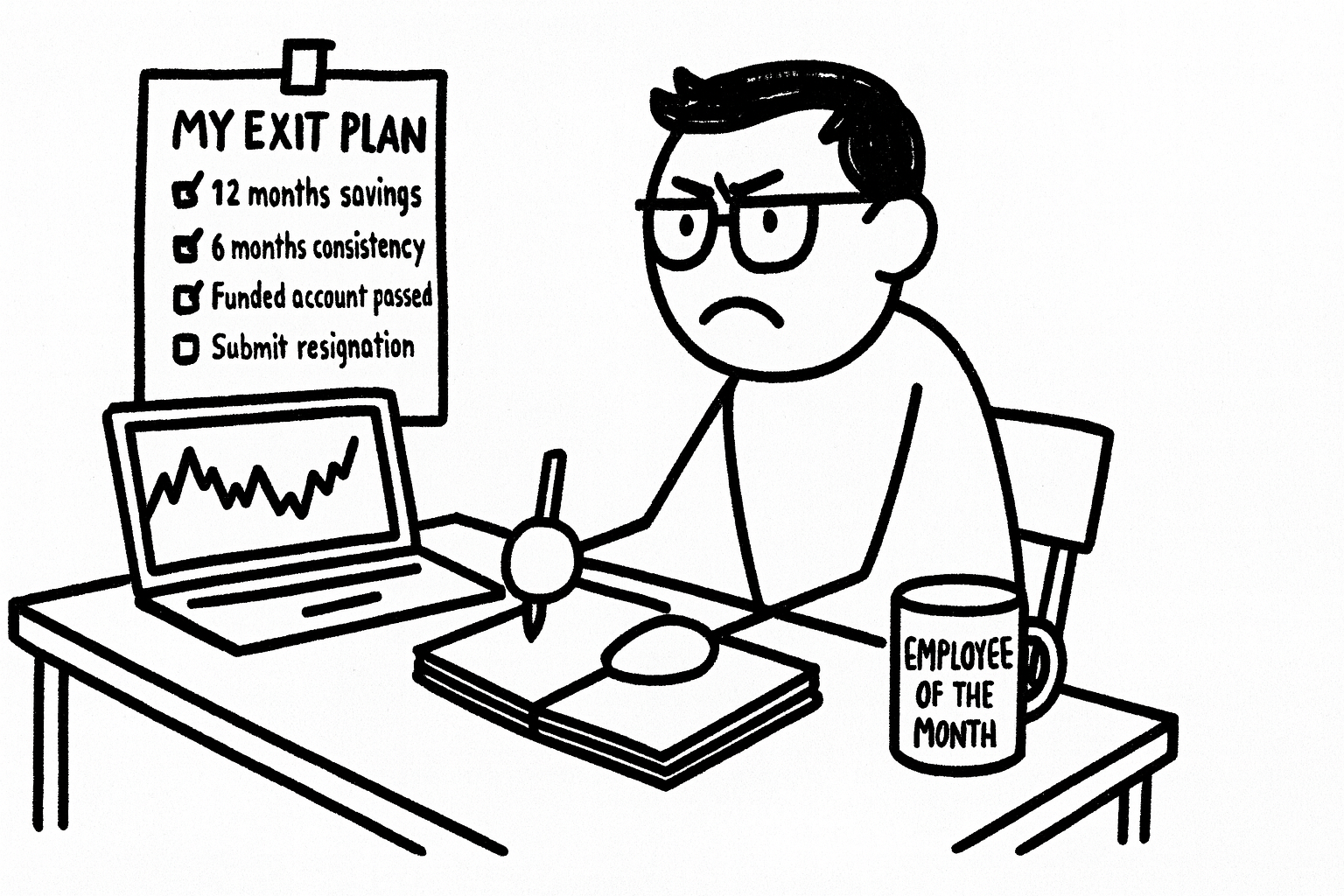
So, you want to leave your 9-to-5 job and trade full-time?
Yeah—me too.
But I’m not just going to YOLO my way out of the corporate world.
I’m building my runway. My cushion. My exit plan.
Because trading full-time isn’t just about the money.
It’s about surviving the pressure after the paycheck stops.
Let me walk you through my plan, so you can build your own too.
🧠 Why Most People Fail When Quitting Their Job to Trade
Let’s be real.
Most aspiring traders quit their jobs too soon, often without a financial exit plan, an emergency fund, or any understanding of what it’s like to trade when rent’s due in three days.
They go all in on hope…
…and get crushed by reality.
You see, when your trades have to pay your bills, your psychology shifts.
It’s no longer just a setup—it’s your survival.
And that’s a recipe for bad decisions.
So before I even think of going full-time, I asked myself:
- How many months of expenses do I have saved?
- Have I hit consistent returns over the past 6–12 months?
- Can I handle drawdowns without panicking?
If the answer to any of these is no, then it’s not time.
💸 My Safety Net: The Financial Cushion I’m Building
Before I even consider quitting my job, here’s what I’m stacking:
- 6 to 12 months of living expenses in a separate account
- A small trading account I’ve grown consistently without risking more than 1–2% per trade
- A “burnout buffer”—because let’s face it, trading full-time can be mentally draining
This isn’t just budgeting. This is risk management for career traders.
And I’m not stopping at the money. I’m also:
- Running backtests on my system
- Reviewing metrics weekly
- Practising capital preservation, not just profits
Because the goal isn’t to trade full-time.
The goal is to trade full-time sustainably.
⏳ Trading While I Work My 9 to 5
Yup—I’m still working. Full time.
But I’m also:
- Reviewing markets before work
- Placing orders with alerts and automation
- Using my lunch break to journal and adjust
- Doing weekly reviews on Sundays
Is it easy?
No.
But it’s proof that I can be disciplined even with limited time.
That’s what full-time trading requires—structure, not freedom.
🧘♂️ Mindset: The Hardest Part of Trading for a Living
You know what’s scarier than the market?
Self-doubt.
- “What if I’m not good enough?”
- “What if I blow up my savings?”
- “What if I just got lucky?”
These thoughts creep in—even now.
That’s why I’m working on more than just charts. I’m working on trader psychology:
- Building confidence to trade for a living
- Practising emotional control during losing streaks
- Tracking my performance metrics, not my P&L
Because your brain can sabotage you faster than the market ever will.
🗺️ My Exit Strategy: The Checklist Before I Quit
Here’s the actual checklist I’m using. Feel free to steal it:
✅ 12 months of expenses saved
✅ Proven trading edge with 6+ months of consistency
✅ Trading journal updated weekly
✅ Written trading plan (with risk and money management rules)
✅ Monthly performance reviews
✅ At least one non-trading source of income
✅ Mental readiness (trading no longer feels emotional)
Only when all of these are checked will I even think about walking away from my job.
Because leaving a job isn’t a flex. Staying consistent without one is.
💬 Final Thoughts: Trade Smart, Not Desperate
Quitting your 9-to-5 to become a full-time trader might be your dream.
It’s mine too.
But don’t let the dream rush the process.
Because the best traders I know didn’t gamble on a fantasy.
They prepared like professionals.
They managed risk like engineers.
And they executed like assassins.
So if you’re building your exit plan…
Take your time.
Build your cushion.
Sharpen your edge.
Pro Tip: Before quitting your job, consider passing a funded trader evaluation.
It’s the ultimate pressure test. No better way to prove your consistency, control your risk, and validate your strategy—without putting your capital at risk.
If you can manage a funded account under strict rules while juggling your 9 to 5, you’re closer to full-time trading than you think.
👉 Start your funded journey with Blusky.pro


