Here’s what I’ve learned watching people change—across health, relationships, work, and money:
You don’t change your life by forcing change.
You change your life by paying attention.
This principle applies everywhere.
Why Paying Attention Works
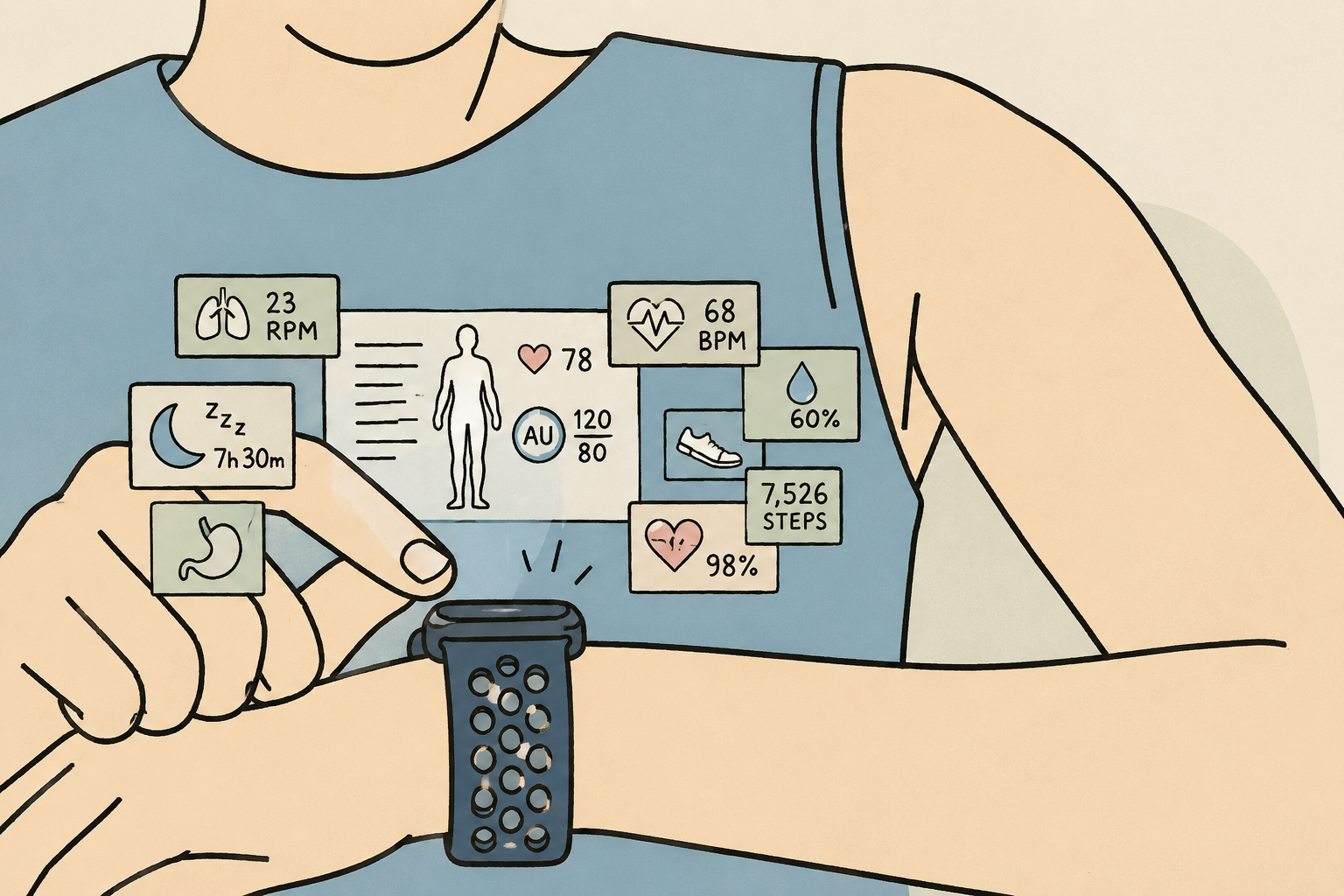
Monitoring is a super power. You don’t need heroic discipline or dramatic reinvention. Simply noticing what you do—without judgment—often shifts behavior on its own.
Awareness creates accountability.
Accountability strengthens self-control.
We manage what we monitor.
But monitoring only works when it’s specific.
“Read ten pages a day” can be tracked.
“Be more informed” cannot.
If you want something to count in your life, you have to find a way to count it.
Which leads to the question: what’s worth counting?
When we guess, we’re usually wrong. We underestimate our excesses and overestimate our effort. Numbers don’t argue.
I learned this through my friend, who lives with type 1 diabetes. She wears a glucose monitor that doesn’t tell her what to do or fix anything for her. It just shows the numbers—continuously.
That alone changes behavior.
Because you can’t argue with data.
That’s monitoring at its best: removing comforting stories and replacing them with clarity. No judgment. Just feedback.
Used wisely, monitoring nudges behavior without force. Small adjustments compound. Progress replaces perfection.
But monitoring has a cost. It takes time and mental energy. That’s why it shouldn’t be applied to everything. Track what truly shapes your health, your time, your relationships, your peace of mind—and let the rest go.
Why Trading Might be Different
Traders are already living inside relentless monitoring.
Your P&L updates in real time.
Your broker statement is brutally honest.
So the problem in trading is not lack of awareness.
The problem is that raw awareness triggers emotion.
Seeing yourself down $2,000 doesn’t create accountability—it creates panic that demands immediate action in an environment where immediate action is usually wrong.
This is why generic self-improvement advice often fails traders.
Your Nervous System
The glucose monitor analogy still applies—but with a crucial distinction.
My friend doesn’t stare at her readings all day in a panic. She uses the data to adjust behavior, not to emotionally react.
Traders often do the opposite.
Monitoring without emotional regulation is just anxiety.
You can’t negotiate with data—but you can absolutely misuse it.
This Separates Amateurs from Pros
Most struggling traders monitor outcomes:
- P&L
- Win rate
- Daily drawdown
- Equity curve (checked obsessively)
- Professional traders monitor process:
- Did I wait for my setup?
- Did I size correctly?
- Did I honor my stop?
- Did I follow my plan—even under stress?
If you monitor only outcomes, you trade emotionally.
If you monitor process, outcomes improve as a side effect.
This single distinction explains why two traders with the same strategy can have radically different results.
The Monitoring Trap
More monitoring is not better.
In trading, excessive monitoring is a common failure mode:
Watching every tick
Checking intraday P&L compulsively
Tracking multiple timeframes, news feeds, and social signals simultaneously
This creates decision fatigue, cognitive overload, and impulsive overrides of good trades.
For many traders, being glued to the screen feels responsible. In reality, it’s often anxiety disguised as diligence.
Sometimes discipline means monitoring less, not more.
Strategic Ignorance Is a Professional Skill
Elite traders are deliberate about what they do not monitor.
A day trader checking monthly P&L during the session is sabotaging themselves.
A swing trader watching five-minute candles is creating noise, not signal.
Many professionals:
- Set the trade and walk away
- Check positions only at predefined times
- Review performance after the market closes
They separate decision time from evaluation time.
That separation protects execution quality.
Real-Time vs. Delayed Monitoring
This distinction is critical:
Real-time monitoring (tick-by-tick P&L, constant checking): often destructive
Delayed monitoring (end-of-day or end-of-week review): usually constructive
Example:
A trader reviews their journal Friday evening and sees they violated position sizing rules three times. That delayed feedback creates a plan for next week.
The same trader checking P&L every 30 minutes Friday morning sees they’re down and revenge-trades to “make it back.”
Rule of thumb:
Review process daily
Review outcomes weekly or monthly
Fast feedback on behavior.
Slow feedback on results.
What Traders Should Actually Monitor
Effective monitoring in trading is:
- Narrow
- Intentional
- Emotion-aware
Start with one process metric—the one that addresses your biggest leak:
- Rule adherence
- Risk consistency
- Emotional state before and after trades
Execution quality under pressure
Most traders fail by trying to track everything and end up tracking nothing consistently.
The Simplest Tool That Works: A 60-Second Journal
The simplest form of process monitoring:
After each trade:
1. Did I follow my rules? (Y/N)
2. What was my emotional state? (1–10)
3. One thing I did well
That’s it.
This creates accountability without drowning in data.
When Monitoring Reveals a Problem
Don’t rely on willpower.
If monitoring shows you overtrade after losses, don’t “try harder.” Change the environment:
- Reduce size automatically after red days
- Set a max trades per session
- Enforce a 15-minute pause after exits
Let systems do the work willpower can’t.
The Real Purpose of Monitoring
For most of life, monitoring creates clarity.
For traders, selective monitoring creates edge.
Monitor what makes you better.
Ignore what makes you reactive.
The best traders I know close their P&L window during trading hours.
They know exactly what they did.
They have no idea what they made—until the session ends.
That’s the discipline that compounds.
That’s how attention becomes change—
without force,
without drama,
and without fooling yourself.