Last week, I stepped into a midtown Manhattan coworking space, expecting to see confident finance bros flashing Rolexes.
The day-trader persona on Instagram promises success: sports cars, laptop lifestyle, freedom from the 9-to-5 grind.
Instead, I found something that made my stomach turn.
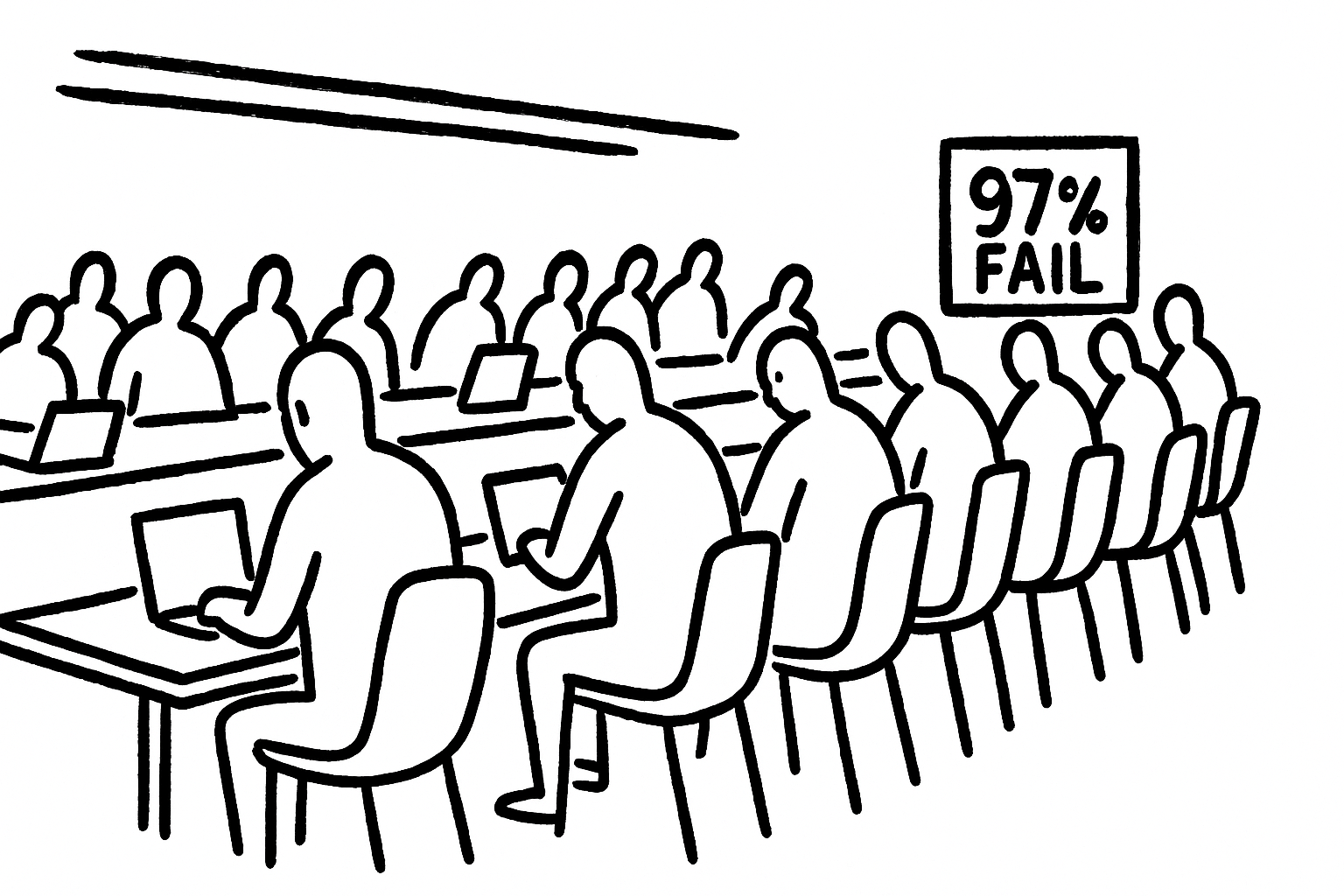
Thirty exhausted office workers shuffled in after long days, clutching notebooks like talismans against financial anxiety. Under fluorescent lights, they prepared to study candlestick charts with the desperate focus of people hoping this might be their only way out.
Every single person in that room was statistically destined to fail. Most had no idea.
I was there to observe a class run by XD, a trading-education company charging hundreds of dollars to teach a skill that 97% of people lose money attempting. What I witnessed wasn’t education — it was a modern gold rush where the only guaranteed winners are selling the shovels.
The Boom Nobody’s Questioning
The numbers are staggering:
- Global searches for “day trading class” are up 700% this quarter, hitting all-time highs.
- “Trading coach” searches: up 325%.
- “Day trading group” searches: up 572%.
- Coursera reports a 213% growth in trading-course enrollment since 2019.
XD’s CEO, Mr D, has built a thriving business on this wave. When I asked what percentage of students become consistently profitable, he deflected: “Success depends on how hard each trader is willing to work.”
That’s the industry’s favourite line. It puts the inevitable failure on the student, not the impossible odds.
The Brutal Math They Don’t Lead With
Albert mentioned this once, briefly, midway through the two-hour session:
A 2020 study found that 97% of investors who day-traded for more than 300 days lost money.
Fewer than 1% earned more than $54 per day.
Read that again. In a room of 30 students, statistically, fewer than one person will even beat minimum wage.
But this fact wasn’t the opening message. It wasn’t plastered on the wall. It was a footnote buried under talk of “working hard enough” and “thinking independently.”
What Mr D didn’t mention:
- You’re competing against high-frequency trading algorithms that execute in microseconds.
- Winning trades get eaten by commissions, spreads, and slippage.
- The market is designed to exploit emotional decision-making — exactly what anxious career-changers bring.
- Social-media “success stories” are usually outliers or fakes selling courses.
- XD doesn’t track verified student success rates — very convenient.
The Room Where Dreams Go to Die
Around 30 people — 75% of whom were men — filled the space at 7 p.m. When Mr D asked:
“What were the major market-moving events of 2024?”
Silence. A few hesitant guesses: the presidential election… tariffs… maybe Fed rate cuts.
These people couldn’t name the basic macro forces moving the market they planned to trade.
That’s like trying to perform surgery without knowing human anatomy.
Instead of warning them they weren’t ready — that they needed months of studying economics, Fed policy, and earnings before risking real money — Mr D moved straight into technical analysis: candlesticks, support/resistance, the 200-day moving average.
Useful tools. Completely insufficient if you don’t know what actually moves the price.
I overheard students debating Palantir option contracts while unable to explain what the Federal Reserve does.
Meet the Hopeful — and Their Odds
Behind every notebook was a human story:
- JV, 23, who was recently laid off, has spent $900 on trading courses — nearly two weeks’ worth of minimum-wage work.
- YR, 21, dreams of trading “two to three hours a day” while travelling. He studies three hours daily already — unaware that institutional traders with PhDs and million-dollar tools still underperform index funds.
- GA, 50, a former programmer who felt expendable as technology moved on, now trades six to eight hours a day. He calls it early retirement. In reality, he’s grinding at something with worse odds than poker — without the poker player’s risk discipline.
The Industry’s Dirty Secret
Here’s the real playbook:
- Influencers flash wealth (often fake or from selling courses, not trading).
- Desperate or ambitious people pay for “education.”
- Most people lose money trading.
- Failed traders become coaches, recruiting the next wave.
It’s MLM logic applied to markets.
Mr D insisted XD is different: “We teach independent thinking.”
But the whole business model relies on hope overcoming a 97% failure rate.
When I asked for proof — such as brokerage statements and tax returns — I received testimonials and feel-good videos. No auditable results.
What Mr D Gets Right — and Why It Doesn’t Matter
His advice isn’t wrong:
- Master technical analysis ✓
- Understand risk management ✓
- Don’t blindly follow gurus ✓
- Think independently ✓
The problem is that these don’t overcome structural disadvantages.
Retail traders face:
- Worse pricing than institutions
- Slower execution than the algorithms
- Higher fees relative to capital
- Emotionally fragile trading under financial stress
- Delayed information — trading on news institutions saw first
It’s like teaching perfect basketball fundamentals… then sending someone to play the NBA.
The Question Nobody Asks
If day-trading education were effective, why aren’t instructors actually trading?
Mr D might say he loves teaching. However, the business model is clear: sell courses, mentorships, and coaching to people who continue to believe they’re just one lesson away from achieving profits.
Meanwhile, the 97% failure rate rolls on.
The Bottom Line
Step into that classroom and you won’t find finance bros. You’ll find:
- A 23-year-old spending his last dollars on hope
- A college kid is sure he’s found a shortcut
- A 50-year-old tech worker trying to reinvent himself
You’ll see economic anxiety packaged as entrepreneurship — and sold at a premium.
The courses aren’t total scams; students do learn real concepts. But reading charts won’t beat:
- Algorithmic competition
- Structural fee disadvantages
- Information asymmetry
- The math that 97% will lose
Would you pay $900 to learn to beat professional poker players when 97% of students go broke?
That’s this.
The Lamborghinis on Instagram? Mostly bought with course sales — not trading gains.
The only guaranteed winners in the retail boom are the people selling education to those who can least afford to lose.
And every night in midtown Manhattan, another 30 people walk into a fluorescent-lit room, notebooks ready, believing they’ll be the exception.


