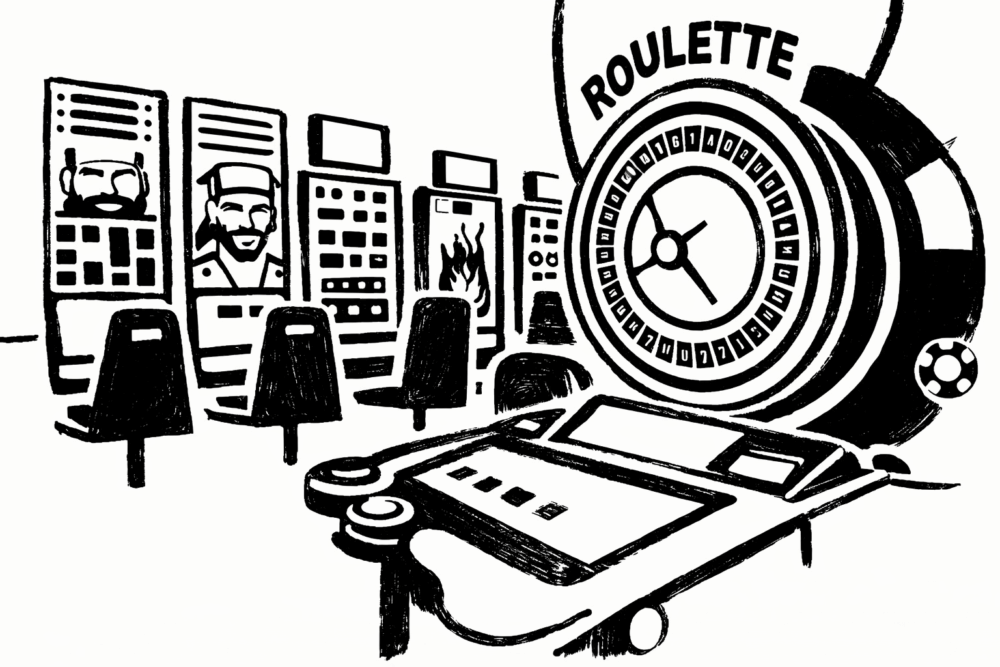
You don’t walk into a casino anymore.
You unlock your phone.
One tap and you’re betting on a football game, an election, or whether a stock hits a price before lunch. Different? Same adrenaline rush.
The Subway Trade
Picture this.
It’s September. Morning rush in New York. People packed shoulder to shoulder on the subway platform, everyone staring into their phones like the future might blink first.
George is one of them.
He’s 25. A student.
He opens an app and buys $128 worth of options on a volatile stock. Not shares. Options. Contracts that expire in a week. If the stock pops above $80, he wins big. If it doesn’t, the entire position goes to zero.
No partial loss. No “maybe next week.” Just win or wipeout.
Ninety minutes later, the trade works. He’s up 84%. Just like that.
On other days, he bets on football games. On mayoral elections. On whether Trump will announce a Bitcoin reserve.
Same phone. Same muscle memory.
“The goal is just to make my money grow,” he says. “If it grows enough to pay tuition, even better.”
And that sentence—innocent, practical, almost responsible—is exactly where the problem starts.
When Everything Feels Like the Same Game
Here’s the truth no app wants you to notice:
The line between investing and gambling didn’t disappear overnight. It faded quietly.
During the pandemic, millions of people poured into markets through apps designed for speed, stimulation, and engagement. Zero-day options. Leveraged ETFs. Event contracts. Memecoins. Prediction markets. Products that move fast and resolve even faster.
You’re no longer deciding whether to own a business. You’re deciding whether something happens today.
Did inflation beat expectations? Did earnings surprise? Did a team win? Did a tweet land?
More markets. More buttons. More reasons to click.
And Wall Street didn’t slow this down. It leaned in. Built better pipes. Sharper interfaces. Faster dopamine.
The casino didn’t move closer to the exchange.
It moved inside it.
The Disappearing World
Gambling used to have friction.
You drove somewhere. You withdrew cash. You felt the weight of the decision before you placed the bet.
Now there’s no pause.
Clinicians say something unsettling: their patients are getting younger, and the losses are getting bigger. Many don’t even think they’re gambling. They’re “trading.” They’re “investing.” They’re “just learning.”
But behavior doesn’t care what you call it.
Constant access is worse than bright lights. The slot machine is always in your pocket—and it never closes.
The Old Trick in a New Costume
This isn’t new. Just upgraded.
In the 1800s, bucket shops let people bet on stock prices without owning anything. The illusion of participation wiped out a generation. After 1929, regulators stepped in.
Then the cycle repeated.
New technology. New speculation. New collapse. New rules. Slow loosening. Repeat.
What’s different now isn’t speed. It’s proximity.
The same ecosystem offers long-term investing tools and instant-resolution bets. Sometimes the same company offers both.
To a beginner, it all feels identical.
Who Actually Makes Money
Here’s a secret professionals don’t romanticize.
They don’t win because they’re smarter. They survive because they size smaller.
Retail traders risk 20%, 30%, sometimes 50% of an account on one idea. Professionals risk 1–2%. Not because they’re cautious—but because they understand math.
Lose 50% twice, you’re done. Lose 1% fifty times, you’re still alive.
Pros aren’t prophets. They exploit emotion. The crowd chases what just worked. Lines move too far. Prices overshoot. That overreaction is the edge.
The money isn’t in being right. It’s in letting other people be wrong—over and over.
So Where’s the Line?
Here’s the uncomfortable answer:
It’s not the product.
It’s the process.
The same option can be a hedge or a lottery ticket. The same trade can be disciplined or desperate. Intent matters—but evidence matters more.
Some firms have quietly admitted this. Vanguard removed zero-day options. Not because options are evil—but because when time is compressed, most people don’t manage risk. They chase outcomes.
Short-dated trades are designed for drama. They resolve fast. They punish impatience. They feel incredible… until they don’t.
Three Questions That Tell the Truth
Forget labels. Forget platforms. Ask yourself these—honestly.
1) Can you define your edge?
Not vibes. Not confidence.
Edge is math:
(Win Rate × Average Win) − (Loss Rate × Average Loss)
If you can’t calculate it, you’re not trading. You’re hoping.
One subway win proves nothing. Edge shows up over hundreds of trades.
2) How much are you risking?
Same trade. Two realities.
$128 risked from $10,000 is discipline. $128 risked from $500 is desperation.
If your position size changes with emotion, you’re not managing risk. Risk is managing you.
3) Are you tracking everything?
Traders log. Gamblers remember.
Memory keeps the wins and deletes the losses. Without a log, you don’t know your drawdown, expectancy, or whether you’re slowly bleeding.
Not tracking isn’t a detail. It’s the line.
The Real Test
George says he has rules. Avoids the open. Studies charts. Looks for mispricing.
That all sounds right.
But discipline isn’t how it feels. It’s what can be proven.
To show this is trading—not gambling—there must be:
- A complete trade log
- 100+ trades
- Average win vs loss
- Maximum drawdown
- Consistent position sizing
Without that, a big win isn’t skill.
It’s variance—before it turns.
The market doesn’t care about your intentions. It rewards a process that survives long enough for edge to matter.
Everything else is just noise with better graphics.


