Mike traded futures for three years with a solid strategy, clean risk management, and a 58% win rate. On paper, he should’ve been fine.
Instead, his account went to zero.
Not because his system was bad, but because he was averaging five hours of sleep and convincing himself it “didn’t matter.”
Months later, after rebuilding, he compared his sleep logs to his trades. The pattern was so consistent it was almost embarrassing:
- 7+ hours sleep → highest win rate, steady profits
- 6–7 hours → performance dipped
- Less than 6 hours → negative expectancy, emotional trades
- Every big loss (over $2,000) → all on <6 hours of sleep
He changed one thing:
He made 7.5 hours in bed non-negotiable.
Same strategy.
Same markets.
Same risk rules.
In the next 120 trading days, he made $52,000.
This is the core idea of this chapter:
Mind + System + Body = Result
If any one of those is unstable, your results will be unstable.
You can have an edge.
You can have discipline.
But if your hardware (your body) is running at 60%, your execution will too.
Let’s break this down clearly.
Sleep Debt: The Hidden Leverage That Blows Traders Up
Sleep deprivation doesn’t feel dangerous. It feels like “grind.” But the data tells another story:
When sleep drops below seven hours:
- Pattern recognition degrades
- Emotional control collapses
- Reaction time slows
- Confidence rises even as performance falls
It’s the perfect trap:
You trade worse while thinking you’re fine.
The Consolidated Sleep + Size Rule
Before trading:
- 7+ hours sleep: trade normally
- 6–7 hours: half-size, A-setups only
- <6 hours: no discretionary trading
This rule also solves the “energy levels” dilemma.
Low sleep = low energy = higher error rate.
It’s the exact mechanism with different labels.
“Did I sleep enough to trust my own judgment today?”
If the answer is no, your size should reflect that.
Stress: Why Traders Double Their Trades During Hard Weeks
Across the small coaching groups I’ve tracked, one pattern shows up again and again:
High-stress weeks = 50–100% more trades.
Not because the market is offering more.
Because stress turns your nervous system into a confusion engine:
- You see danger where there is none
- You shrink your time horizon
- You chase because doing nothing feels unbearable
- Small losses feel catastrophic
- You trade to “feel back in control”
This is not a mental weakness.
It’s chemistry.
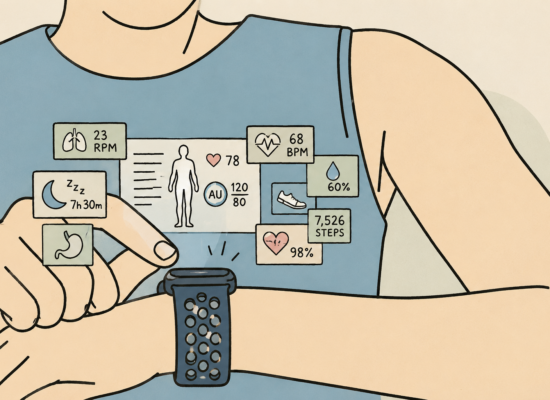
A Simple Stress Check: HRV Traffic Light
Use HRV as a morning red/yellow/green signal:
- Green (baseline or above): full size
- Yellow (10–15% below): half size, A-setups only, limit trades
- Red (20%+ below): no discretionary trading
This prevents the emotional spirals that wreck accounts.
The Afternoon Crash (2–4 PM): What To Actually Do
Almost every trader hits a cognitive wall between 2–4 PM.
Your body temperature dips, your alertness drops, and your decisions get foggy.
Instead of trying to “power through,” pick one rule and stick to it:
Option A — No New Trades
From 2–4 PM: manage positions only, no fresh entries.
Option B — Half Size, A-Setups Only
Keep risk tiny and selective in this low-clarity window.
Option C — Full Break
Leave your desk. Move. Drink water. Reset.
Check your journal.
If your 2–4 PM trades are consistently worse, stop trying to be a hero. Protect your edge.
A 10-Minute Routine
You don’t need a gym body. You need a trader’s body — one that stays sharp under pressure.
Here’s a routine that actually changes brain chemistry in under 10 minutes.
The Pre-Market 10-Minute Activation
Minutes 0–3 — Wake Up the Brain
Do any combo of:
- 20 jumping jacks
- 10–15 squats
- 10 pushups
- 20 mountain climbers
This boosts blood flow and clears overnight grogginess.
Minutes 3–6 — Calm the Nervous System
Box breathing (4-4-4-4).
This balances alertness and calm.
Minutes 6–10 — Mental Rehearsal
Review your plan.
Visualize:
- Taking an A-setup
- Taking a stop loss cleanly
- Closing the platform on time
This reduces emotional volatility during the session.
Intraday Reset (Every 90 Minutes)
- Stand up
- 15 squats
- 10 pushups
- Walk for 2 minutes (no phone, no charts)
This is your cognitive “refresh button.”
The 30-Day Stability Test: Are You Even Ready for Real Money?
Your trading results will never be more stable than your routines.
For 30 days, track:
- Sleep
- Energy (1–10)
- Stress (simple low/med/high)
- Movement
- Rule breaks
- R-multiples
What if you fail Week 2?
Good.
That’s data.
This chapter is not about perfection — it’s about correlation.
If you sleep 5 hours for three nights and your next session is full of sloppy exits and random trades, you just discovered something priceless:
Your P&L is tied to your physiology.
You’re not trying to be perfect.
You’re trying to be informed.
Recovery: Burnout Protection for People Who Want to Trade Long-Term
Burnout doesn’t hit quickly.
It builds in silence.
Three Layers of Protection:
1. Intraday:
Reset every 90 minutes.
2. Weekly:
One full day with zero trading content.
3. Quarterly:
One full week off.
Why a week?
Because traders who skip this tend to hit major burnout spirals around the 9–12 month mark — usually followed by their largest drawdowns of the year.
Your brain needs a “system reboot.”
The Trading Fast: When Your Emotions Are Managing You
A trading fast (2–4 weeks off from live trading) is not a punishment.
It’s a reset.
Use these triggers:
- Three or more revenge trades in a day
- A 10%+ drawdown caused by rule-breaking
- Obsessive chart-checking
- Moving stops to avoid taking a loss
- Trading even when you don’t want to
- Feeling compelled, not strategic
If any of these happen twice in a week, it’s time for a reset.
During the fast:
- No charts
- No live trades
- Review your system only on paper
- Focus on sleep, movement, and clearing the emotional fog
You come back clean, not fragile.
The Strategy Disclaimer You Need to Hear
None of this matters if your system has no edge.
Sleep won’t fix a losing strategy.
Movement won’t turn randomness into a plan.
Stress management won’t magically produce positive expectancy.
Physical optimisation amplifies your edge — it does not replace it.
- If your system works → your body helps you execute it with consistency.
- If your system loses → your body just helps you lose more calmly.
The formula again:
Mind + System + Body = Result
You need all three.
The 30-Day Implementation Plan
Week 1 — Track Everything
Sleep, stress, energy, R-multiples.
No changes yet. Just awareness.
Week 2 — Sleep Foundation
Aim for 7.5 hours in bed.
If you fail — don’t quit. Log the failure and the trading impact.
Week 3 — Movement Protocol
Do the 10-minute pre-market routine + 90-minute resets.
Week 4 — Recovery Layer
Pick your 2–4 PM rule.
Take one full rest day.
Schedule your quarterly week off.
By day 30, you’ll see the truth:
Your P&L has never been “just about the charts.”
It was always about the hardware running the whole operation.
Final Reality Check
You wouldn’t run a server without cooling.
You wouldn’t day trade with a dying laptop.
You wouldn’t use a shaky Wi-Fi connection for scalping.
So why trade with:
- A tired brain
- A stressed nervous system
- A fatigued body
- Zero recovery
Your body isn’t background noise.
It’s your trading infrastructure.
Treat it like the asset it is — or pay for it in your P&L.