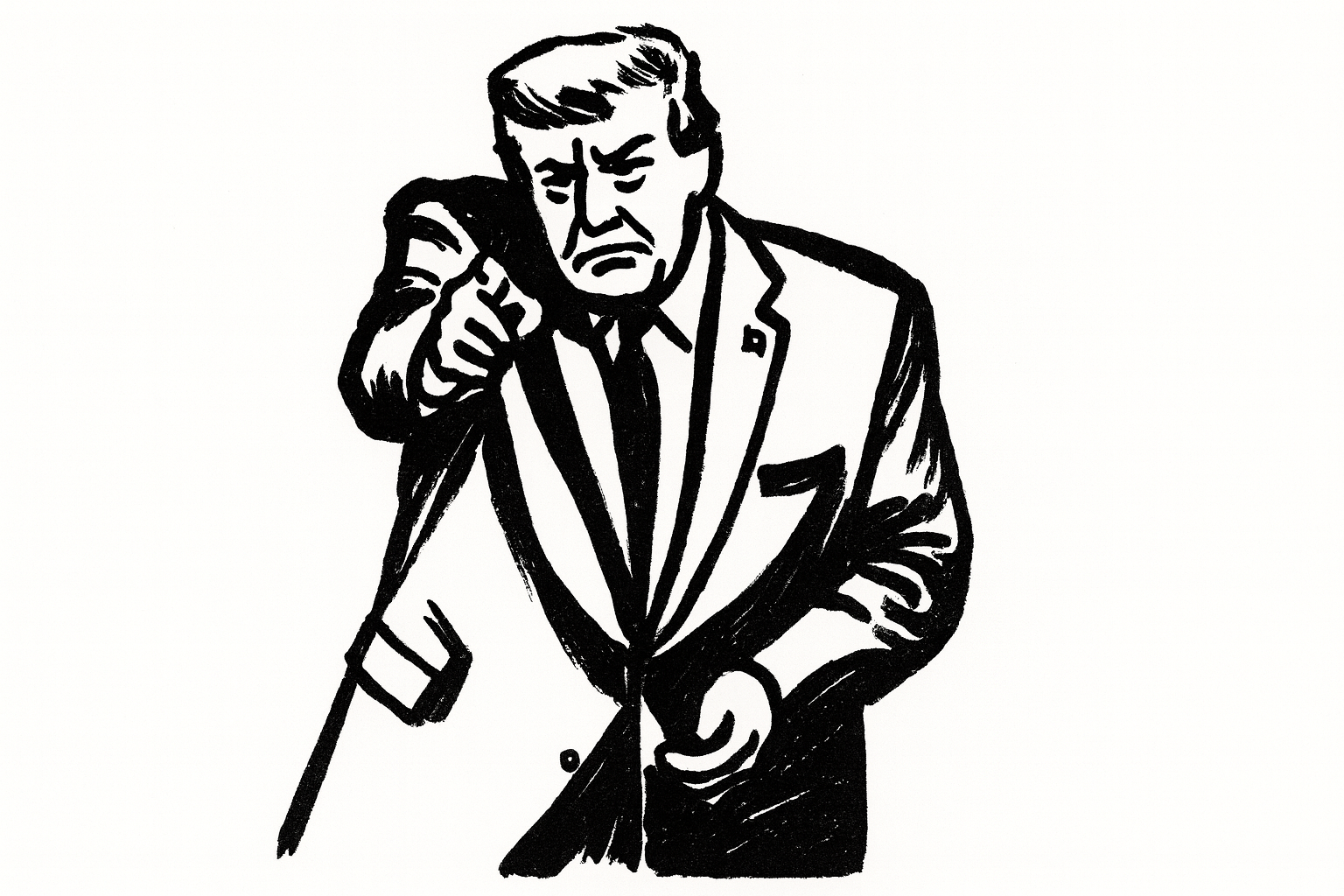
When kindergarten politics meets algorithmic trading, someone’s getting rich — and it’s probably not you.
The Setup Was Almost Too Obvious
Picture this: You wake up, check your phone, and see Trump has slapped a 100% tariff on… well, it doesn’t really matter what. The futures are bleeding red. Your portfolio is down 3% before you’ve had coffee.
You panic sell.
Three days later: “Just kidding!” Markets rise back.
You weren’t invited to that party.
Then China, stone-faced and serious, drops retaliatory measures. Markets tank again.
Rinse. Repeat. Profit — if you know the game.
Welcome to the New Reality: Politics IS Price Action
Forget everything you learned about fundamentals, technical analysis, and “the trend is your friend.” In 2025, there’s only one trend that matters: Trump tweets, markets move, insiders eat.
This isn’t conspiracy theory territory anymore. It’s the trade. The only trade that’s consistently worked while everything else feels like catching falling knives in a funhouse.
The Pattern (Write This Down)
- Phase 1: The Threat — Trump announces aggressive tariffs, usually with maximum hyperbole
- Market reaction: Immediate sell-off
- Your reaction: Panic (if you’re late) or Position (if you’re early)
- Phase 2: The Reversal — Days later, softening stance or “just kidding” energy
- Market reaction: Violent rally back to highs
- Insider reaction: Already positioned from the bottom
- Phase 3: The Retaliation — China (or whoever) responds with actual consequences
- Market reaction: Another leg down
- The cycle: Repeats
If you’re not trading this pattern, you’re funding someone else’s yacht.
But Here’s Where It Gets Dangerous
Trump is playing a high-wire act at all-time market highs. The strategy depends entirely on one assumption: markets will always bounce back.
Every pump can be sold. Every dip can be bought. Bullish news can always save the day.
Until it can’t.
The Risk Nobody’s Pricing In
Here’s what keeps the smart money up at night: What happens when the bounce doesn’t come?
We’re conditioned now. Pavlovian. Bad news = buy the dip. Trump threatens = temporary. The recovery is guaranteed.
Except history says it’s not. Before every major market crash, someone believed they had enough control to prevent it. Enough data. Enough tools. Enough influence to drop “bullish news” and save the day.
They were wrong every time.
One commentator nailed it: “They believed they could do this before every market crash. We’re just along for the ride.”
The ride is exhilarating — until you realise the brakes might be fake.
The “Controlled Burn” Theory (Or: How the Rich Sleep at Night)
Some argue this volatility actually serves a purpose. Think of it as a controlled burn in forest management — creating smaller, manageable fires to prevent catastrophic ones.
Each tariff cycle:
- Burns off excess speculation
- Shakes out weak hands
- Resets sentiment
- Provides liquidity opportunities for those “in the know”
It’s elegant. It’s almost believable. And it benefits exactly one group: people who know what’s coming before you do.
The rest of us? We’re the fuel for the controlled burn.
What About the Farmers? (Spoiler: He Doesn’t Care)
While markets whipsaw and portfolios swing wildly, actual businesses are getting crushed. Farmers can’t plan. Manufacturers can’t forecast. Small businesses can’t hedge these moves like Goldman Sachs can.
Trump’s focus isn’t on Main Street economics. It’s on manipulating price action.
The justification? “Making trade lucrative for both sides instead of disproportionately benefiting the other party.”
Translation: Using market volatility as leverage in negotiations, regardless of collateral damage.
The China Angle (Or: Why Everyone’s Fighting Over the Narrative)
Here’s where it gets messy.
Some rush to defend Trump’s approach: “At least he’s not preventing access to materials — he’s just making terms more favourable!”
Others point out China’s hardball: “Play by our rules on monopolised materials, or get nothing.”
The debate misses the point for traders. We don’t care about the geopolitical morality play. We care about volatility and opportunity.
China says “we don’t fool around,” and markets react violently. That’s the signal. That’s the trade.
Who’s “right” is a question for historians. Who’s profitable is a question for your P&L.
So, When Does This End?
The question everyone’s asking. The answer nobody wants to hear:
When it stops being profitable for the people in power.
As long as the wealthy can:
- Pump their portfolios with threat announcements
- Sell before the public panics
- Buy back cheap during the tank
- Switch to the next pumping market
- Repeat
…this game continues.
The moment volatility stops enriching insiders? That’s when policy becomes boring again.
Don’t hold your breath.
The Day Trader’s Playbook (What to Actually Do)
- Stop Being Surprised — This is the pattern now. Accept it. Trade it. Stop acting shocked when it repeats.
- Watch the Tweet Timestamps — Patterns emerge. When does Trump typically drop bombs? Pre-market? During hours? Timing is everything.
- Follow the Smart Money — Unusual options activity before announcements? Someone knows something. Watch the flow.
- Size Your Risk for Whipsaw — Markets can gap violently in either direction. Your stops might not save you.
- Remember: The Bounce Is Real Until It Isn’t — Trade the pattern but respect the risk. One failed bounce could cascade into real panic.
- Trade Instruments, Not Ideology — China-exposed stocks, volatility products, currency pairs, sector rotation plays. Leave the political opinions at the door.
The Final Word
We’re living through what might be the most transparently manipulated market environment in modern history. Everyone can see it. Everyone talks about it. And somehow, it keeps working.
Maybe it’s a sign of institutional control. Maybe it’s a bubble in confidence itself.
Either way, the game is simple:
- They make the announcements
- Markets move violently
- Someone profits enormously
- The cycle repeats
You can be outraged. You can be philosophical. Or you can pattern-trade it and try to grab a slice before the music stops.
Just remember: In musical chairs, there’s always one less seat than players.
The question isn’t whether the music will stop. It’s whether you’ll be holding the bag when it does.
What’s your take? Are you trading the tariff whipsaw or sitting it out? Drop your strategy in the comments — let’s compare notes before the next Trump bomb drops.


