Scroll back through old Reddit threads and you’ll notice something:
People who used to post every day about trading have disappeared.
That’s not because they couldn’t find a strategy.
It’s because they couldn’t survive the mental grind of uncertainty.
Day trading looks easy when you see a screenshot of someone making $5K before lunch.
What you don’t see are the weeks where nothing works, the setups that fail three times in a row, and the emotional toll of watching your P&L swing like a heartbeat.
Most traders don’t quit because they run out of money.
They quit because they run out of patience and emotional capital.
The Market Exposes You
Your impulsiveness.
Your ego.
Your fear of missing out.
All of it shows up in your trades.
Beginners think the answer is a better indicator or a new setup.
But the problem is almost always psychological.
You can have the best system in the world —
If you can’t sit on your hands when it hurts, you’ll bleed out slowly and walk away.
The traders who can last, learn to trade in boredom, not excitement.
They stop trying to “make something happen” and focus on managing risk and letting probabilities play out.
The Capital Reality
Another reason many wash out: undercapitalization.
If you’re trying to make $300–$400 a day responsibly, you really need a six-figure account.
The average retail account is about $3,500 — that forces oversized risk and emotional swings.
What you can do instead –
Take a $5,000 live account on Tradovate as an example.
The account can’t drop below $500 — so your effective max drawdown is $4,500.
If you spread that $4,500 over 20 consecutive losing trades, that’s about $225 risk per trade.
Knock off about $25 per trade for commissions and slippage, and you’re realistically risking $200 per trade.
With a 1:2 risk-to-reward, that’s $400 profit on a winning trade.
At 1:3, it’s $600 per trade.
No, $400–$600 isn’t $60K a day — but it’s still serious money if you can do it consistently.
And if you leave the profits in the account and let it grow over a year, your risk per trade (and potential gains) can increase responsibly without blowing up the account.
Many traders look at funded prop firms. They can provide more buying power, but remember that trailing drawdowns, daily loss caps, and scaling plans all come with their own limitations.
Prop firms are tools, not magic shortcuts.
What Actually Wins
- Survive long enough to let skill compound.
- Size risk so you can stay in the game.
- Accept boredom as part of the edge.
- Work on your psychology as hard as you work on entries.
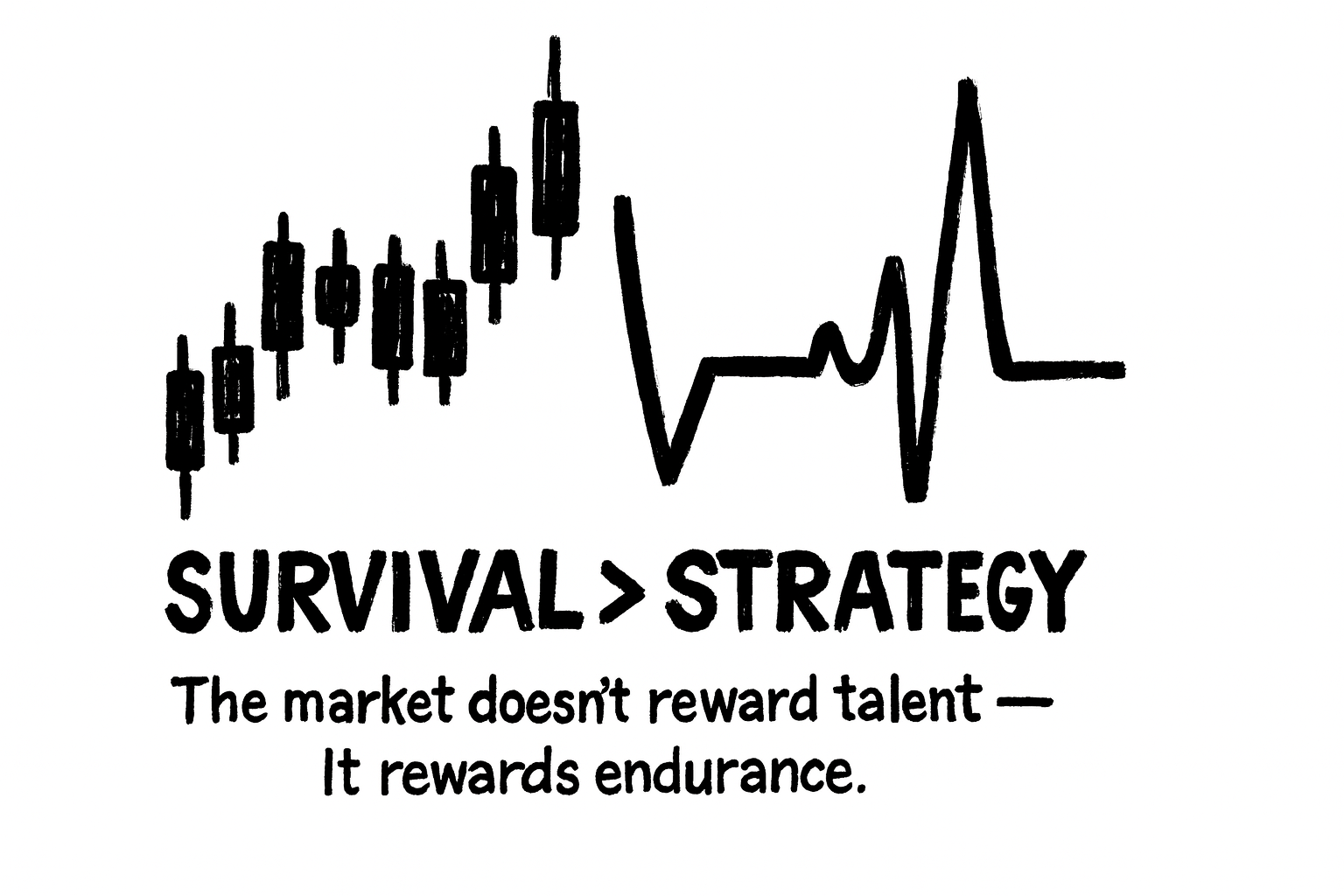
The market doesn’t reward talent.
It rewards endurance.
💬 If you’re in the grind right now — don’t quit just because it’s slow and laborious.
That’s the job.


