Day trading isn’t just about charts, indicators, or setups. It’s about whether your nervous system can handle stress without blowing up.
I once watched a hedge fund manager lose $2 million on a single trade. No panic. No slammed desk. Just two words:
“Next trade.”
Three months later, he’d made $8M back. That wasn’t luck. That was engineered psychological dominance.
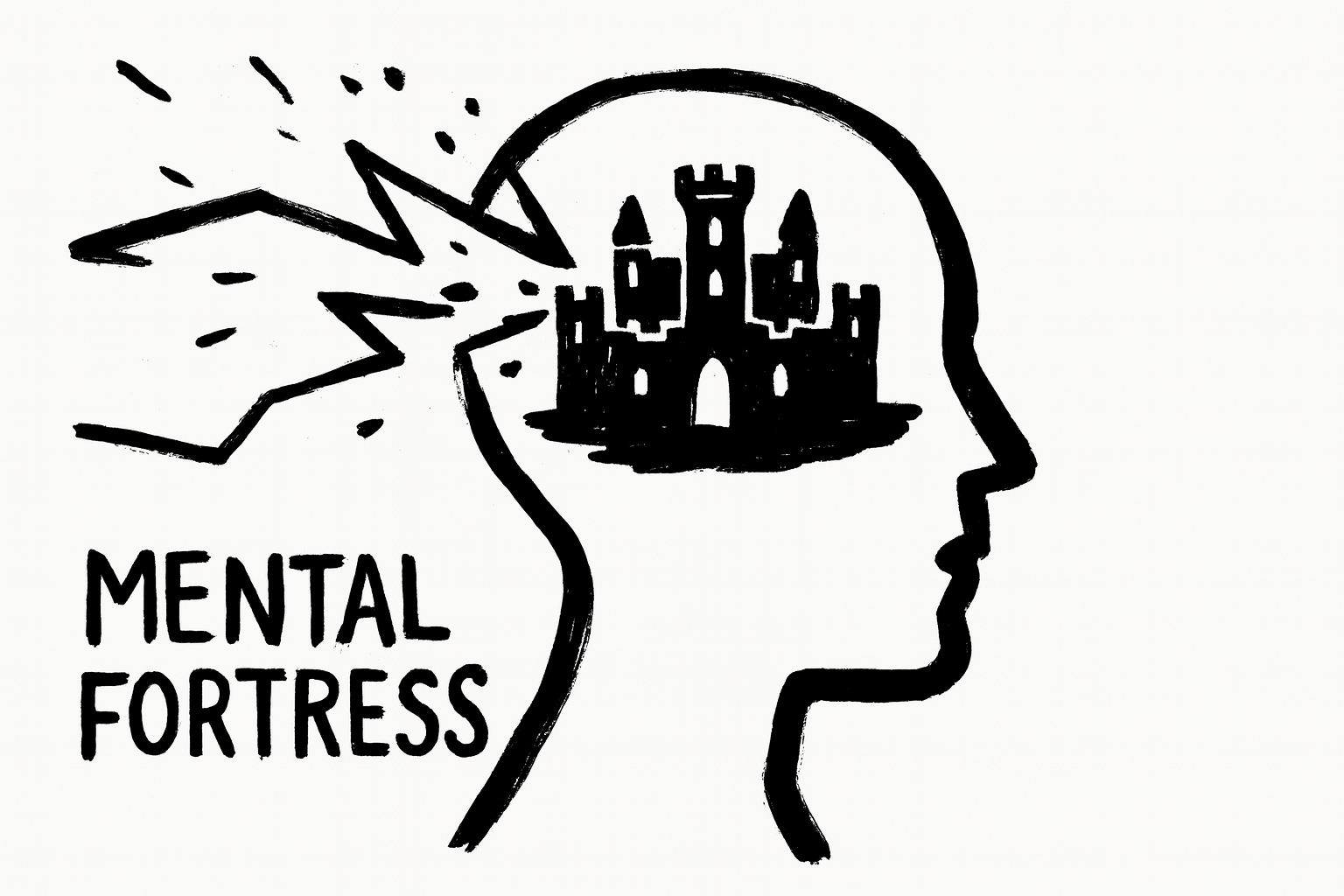
Most traders don’t fail because of bad entries—they fail because their mental architecture collapses under pressure. This is where the Mental Fortress Protocol comes in.
The Hidden Hack of Trading Psychology
Neuroscience proves it: your brain rewires based on how you handle stress.
- Avoid discomfort → your brain hardwires fragility.
- Expose yourself to stress in controlled doses → your brain learns to stay calm.
The best traders unknowingly run “stress inoculation training.” Small exposures to volatility, size, and loss until their system stops seeing it as a threat.
Most retail traders do the opposite: they chase comfort, avoid size, engage in revenge trading, and then wonder why they keep blowing up.
The 3-Layer Mental Fortress for Traders
1. Physiological Foundation (The Hardware)
Your body sets the ceiling for your mind. Build these protocols in:
- 4-7-8 breathing before entries → slows heart rate so you don’t FOMO-click.
- Cold showers post-session → trains calm in discomfort, the same state you need during drawdowns.
2. Cognitive Architecture (The Software)
Strong traders use better mental models:
- 10-10-10 rule → Will this loss matter in 10 minutes, 10 months, 10 years? Keeps daily loss caps sacred.
- Failure forensics → Journal every red trade. Losses aren’t pain; they’re market intelligence.
- Energy audit → Track when you trade well vs. when you overtrade. Cut dead sessions.
3. Environmental Design (The Context)
Your environment should protect your edge, not sabotage it:
- Add friction to bad habits (disable one-click revenge trades).
- Remove friction from good habits (auto-export trades into your journal).
- Audit your circle—hang with traders who build, not those who complain.
The Compound Effect of Discomfort
Mental toughness grows like an equity curve: slow at first, then exponential.
- Weeks 1-2 → Cold showers, journaling, avoiding FOMO trades.
- Weeks 3-8 → Stick to daily loss caps, trade only A+ setups.
- Months 3-6 → System upgrades—strict risk plans, accountability.
- Year 1+ → Psychological dominance. Calm execution. Consistent scaling.
Most quit in Week 2 because they expect linear results. Trading psychology compounds like interest—you need to survive long enough to see it kick in.
The Dark Side of Mental Strength
Real toughness comes with trade-offs:
- You’ll feel detached when others panic.
- You’ll lose friends who bond over complaining.
- You’ll face loneliness—because steady execution isn’t sexy.
That’s the point. You’re not building resilience to fit in. You’re building it to stay funded and compound.
The Trader’s Fortress Mindset
Elite traders see the game differently:
- Losses = tuition.
- Stress = activation.
- Problems = projects.
When chaos hits, you don’t “find discipline.” You rely on systems you built during calm markets.
The question isn’t if you’ll face stress—it’s whether your fortress is ready when it arrives.
❓ Trader Psychology FAQ
Why do 90% of day traders lose money due to psychology?
Because their nervous system isn’t trained for stress, when cortisol spikes after a loss, IQ drops 15–20 points, and time horizons shrink to seconds. Most traders operate in a fight-or-flight mode, making emotional decisions rather than systematic ones. Training methods like HRV training, stress inoculation, and nervous system regulation can tip the edge.
How do you stop revenge trading after big losses?
Revenge trading is cortisol hijacking your brain. The fix: After a loss, use a 90-second breathing reset (focus on inhaling and exhaling), then take a mandatory 3-minute break before your next order. Some traders also use a “pattern interrupt,” such as counting backwards from 100 by 7s. Both break the emotional loop that ruins the following three to four trades.
What breathing techniques are most effective for managing trading anxiety?
The 4-7-8 breath is king. Inhale for 4, hold 7, exhale 8. This activates the vagus nerve, which helps lower stress. Done for 6 minutes pre-market, it boosts HRV for 4–6 hours. Use it immediately after a loss to reset. Box breathing (4-4-4-4) also works well while reviewing watchlists.
How long does it take to build an unbreakable trading discipline?
It happens in phases:
- Weeks 1–4 → stress response regulation
- Month 3 → better decision quality
- Month 6 → autonomic control
- Year 1 → complete rewiring
Most traders quit around Month 2–3, the “neuroplasticity valley,” when changes feel slow. The exponential benefits appear between Month 4–6.
Can you overcome trading addiction and FOMO naturally?
Yes. Both stem from dopamine irregularities. Solutions include:
- Celebrate weekly P&L, not single trades.
- Do dopamine fasts (24 hours off markets/screens).
- Use a delayed gratification ladder: wait 5 minutes before making an impulse trade, then extend the wait to 15 minutes.
Cold exposure also builds impulse control by strengthening the prefrontal cortex.
What supplements can help alleviate trading stress and improve focus?
- Magnesium glycinate (200–400mg) → reduces cortisol spikes.
- L-theanine (100–200mg) → calm focus without drowsiness.
- Ashwagandha (300–600mg) → stress adaptation.
Avoid heavy stimulants during trading—they fuel anxiety. Best results are achieved when combined with HRV training, cold exposure, and proper sleep (7.5–8.5 hours, in a cool room).
How do you stay calm during market volatility and flash crashes?
Through stress inoculation—gradual exposure to volatility and size until your nervous system stops panicking. In real time, use:
- Pressure breathing (exhaling slowly through pursed lips).
- Bilateral stimulation (cross-body movements).
Elite traders can hold a 62 BPM heart rate while managing eight-figure positions.
Why do traders make bad decisions when emotional?
Because the amygdala hijacks the prefrontal cortex under stress, blood flow shifts from rational areas to survival centres, cutting IQ by 15–20 points. This triggers binary thinking, FOMO, and poor risk assessment. Training parasympathetic dominance through HRV and vagus nerve work is the fix.
How do professional traders manage emotions differently from retail?
Pros don’t rely on willpower—they engineer emotional control:
- Biofeedback to track HRV.
- Pre-set risk parameters.
- The 3-trade rule (max 3 discretionary calls per session).
- Environmental design to block distractions.
Goldman Sachs even spends $40K per trader on biofeedback training. Retail traders usually rely on “motivation,” which fails under stress.
What is the Neural Edge Protocol for trading psychology?
It’s a systematic nervous system rewiring system used by 8-figure traders. It combines:
- HRV training + cold exposure
- Cognitive load management (reduce decision fatigue)
- Parasympathetic training under stress
Results:
- 67% fewer stress errors
- 34% better trade timing
- 52% drop in revenge trading within 6 months
💡 Next Read for Serious Traders
If you’re building your mental fortress, the next step is learning how to survive the gauntlet of prop firm evaluations.
👉 Read: Prop Firm Survival Guide: Guardrails That Keep You Funded
⚡ More from Funded Nest
- Prop Firm Evaluation Tips → Pass without blowing your daily loss cap.
- How Prop Traders Manage Stress → Elite routines for chaos-proof execution.
- STAY CALM Trading Framework → The mindset system that keeps you consistent.
🔥 Trading psychology isn’t motivation—it’s risk survival engineering.
Build your fortress. Then take it into battle.