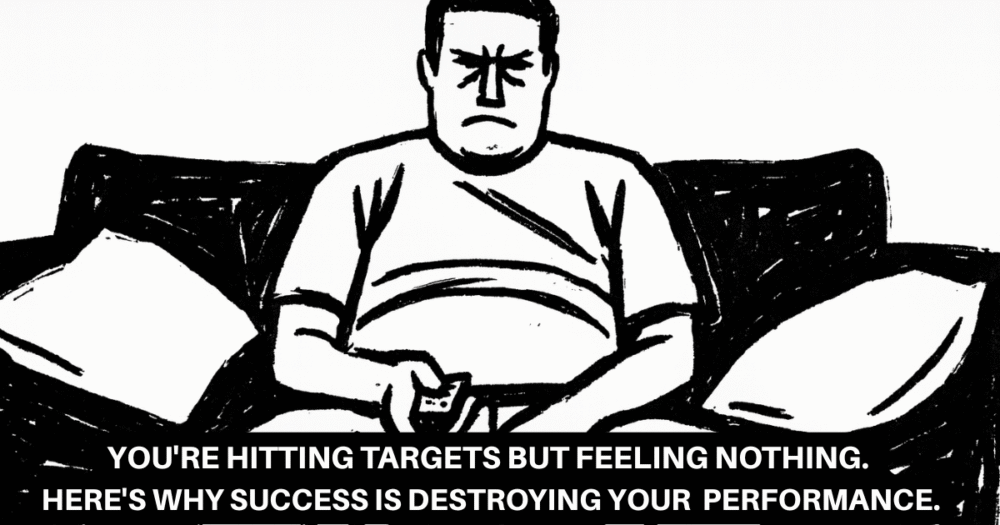
The most dangerous moment in trading isn’t when you’re losing money—it’s when making money stops mattering.
Your system is working. Risk management is tight. You’re hitting targets. But green days feel empty, red days feel expected. The thrill of a perfect entry is replaced by the dull satisfaction of another completed trade.
You’re profitable, but not present. Winning, but not alive. That’s trader’s anhedonia—when success becomes your biggest risk.
Trading Psychology: The Silent Killer of Performance
Most think the biggest threat is a blown account. The real danger? Emotional flatness.
You nail a breakout and feel nothing. Dodge a reversal and shrug. Post your best month ever and immediately worry about next month. This isn’t fear—it’s your brain normalising success until wins feel ordinary.
And ordinary traders get eaten alive.
Dopamine in Trading: Why Winning Streaks Become Weakness
The brain craves novelty. What thrilled you in your first 100 trades feels routine by your thousandth. That’s dopamine fatigue.
The result?
- Pattern recognition dulls.
- Intuition fades.
- Execution turns mechanical instead of mindful.
When you’re on autopilot, you miss the market’s whispers: volatility shifts, tape speed, subtle regime changes. That sixth sense—the edge every pro relies on—blunts.
Meanwhile, hungrier traders with fresh eyes are spotting opportunities you’re blind to.
Comfort kills.
The Lie That Stalls Your Day Trading Edge
“I should be grateful for consistency.”
“This is what mature trading looks like.”
“The excitement was just gambling.”
Stop.
Gratitude doesn’t mean complacency. Discipline doesn’t require numbness. Wanting more isn’t greed—it’s the competitive instinct that separates stagnant traders from evolving ones.
How Successful Traders Keep Their Edge Sharp
The cure isn’t chasing thrills. It’s structured disruption inside risk parameters:
- Hunt New Setups — Test markets, assets, or timeframes outside your comfort zone.
- Embrace Calculated Risks — Size up conviction plays and experiment in unfamiliar regimes.
- Redefine Success Metrics — Track insights gained, not just P&L.
- Challenge Assumptions — Debate with traders who disagree, study failures as thoroughly as wins.
- Stay Beginner-Minded — Trade paper like you’re new again, approach charts with fresh eyes.
Trading Psychology in Action: The Edge of Staying Alive
When you’re engaged, trading transforms:
- You sense momentum shifts before indicators confirm.
- You size with conviction, not formulas.
- You cut losses quicker because you’re present.
- You adapt in real time instead of fighting the tape.
Emotional engagement isn’t a luxury. It’s alpha.
Your Next Trade
If you’re profitable but flat, don’t wait for a drawdown to wake you up. Create your own disruption—responsibly.
This week, study one adjacent market. Next week, paper trade a new setup on paper. Next month, risk 0.25% on whether your edge translates.
Guardrails matter: set loss caps, cap position size, review results, and never risk more than 1% equity on experiments combined.
Not because you’re dissatisfied. Because you know complacency kills edge.
The cure for traders’ anhedonia isn’t more wins. It’s more alive in the process.
The question isn’t whether you can afford to shake up your trading routine.
It’s whether you can afford not to.
Frequently Asked Questions
Q: How do I know if I’m experiencing trading anhedonia versus just normal market fatigue?
Trading anhedonia is characterized by emotional flatness during wins, not just losses. If you’re hitting your profit targets but feeling nothing, or if successful trades feel mechanical rather than satisfying, you’re likely experiencing dopamine tolerance from repetitive success. Normal market fatigue usually involves frustration or stress, while anhedonia involves numbness.
Q: Is it dangerous to experiment with new markets when I’m already profitable?
The real danger is staying in your comfort zone while your pattern recognition dulls and competitors gain an edge. However, always use proper risk management: limit new strategy exposure to 0.25% per trade, maintain daily loss caps, and paper trade extensively before risking real capital. Strategic evolution with guardrails is safer than autopilot trading.
Q: How long does it take to reignite trading passion and market feel?
Most traders notice an improvement in engagement within 2-3 weeks of introducing controlled challenges. However, rebuilding sharp market intuition and pattern recognition can take 1-3 months of consistent practice with new setups or markets. The key is maintaining deliberate practice rather than just going through motions.
Q: What’s the difference between profitable trader burnout and regular burnout?
Profitable trader burnout involves emotional numbness despite financial success. You execute trades mechanically, miss regime changes, and lose your sense of market momentum shifts. Regular burnout typically involves stress, overtrading, or poor performance. With profitable burnout, your P&L may appear fine, while your competitive edge deteriorates.
Q: Can trading psychology coaching help with motivational decline?
Yes, but focus on coaches who understand performance optimisation rather than just emotional support. Look for those who address dopamine tolerance, reward system adaptation, and strategic skill development. The best approach combines psychological techniques with practical trading skill expansion.
Q: Should scalpers and swing traders use different approaches to combat emotional flatness?
Absolutely. Scalpers should focus on reading order flow in different markets (forex scalpers trying crypto, equity scalpers testing futures). Swing traders benefit from exploring different time frames or conducting fundamental analysis. Day traders should experiment with overnight positions or different sector rotations to optimise their trading strategies. Each style requires tailored challenges.
Q: How do I maintain risk management while seeking intellectual challenges?
Establish hard limits before experimenting, including a 2% maximum daily loss, position size caps for new strategies, and mandatory review cycles. Never risk more than 1% total account equity on experimental trades combined. Set learning objectives separate from profit objectives, and always prove an edge through paper trading before scaling real money.
Q: What are the warning signs that I’m overcorrecting into reckless experimentation?
Red flags include abandoning proven strategies completely, sizing up aggressively on untested setups, ignoring daily loss limits, or chasing excitement rather than edge. Healthy experimentation involves small position sizes, extensive journaling, and gradual skill building. If you’re making dramatic changes quickly, you’re likely overcorrecting.


