If you’re reading this while your account is red, your family feels distant, and you’re wondering how you got here, you’re not alone. The traders in these stories felt exactly what you’re feeling right now.
Prop firms are everywhere. YouTube thumbnails promise “$10K in a Day Trading Futures!” TikToks show flashy dashboards and quick payouts. The dream sells itself — quit your job, pass a funded trader challenge, trade for freedom.
But away from the curated highlight reels, traders share a different side of the story. Real traders. Real losses. Real consequences that go far beyond blown accounts.
If you’re struggling, these stories might be the mirror you need to look into.
Are You in the Danger Zone?
Before we dive into these stories, take an honest look at yourself. You might be in dangerous territory if:
- You check the charts before saying good morning to your family
- Red days affect how you treat people around you
- You’ve lied about losses or time spent trading
- You trade angrily, trying to “get even” with the market
- Your sleep schedule revolves around market hours
- You’ve borrowed money to trade
- You can’t have a family dinner without thinking about positions
- You feel like trading is the only way to prove your worth
If any of these hit close to home, keep reading. These stories are for you.
Story One: “I Lost More Than Money”
This trader’s dream was the same as yours: freedom for his family, more time with his daughter. Financial independence. Control over his life.
He thought the hardest part of trading would be losing money. Blown accounts, failed evaluations, and stop hunts. But the truth cut deeper — he lost himself, and eventually, his family.
The spiral looked like this:
Obsession disguised as grind. Killzones in London, then New York. Alerts are buzzing at all hours. Indicators are stacked on every timeframe. $8K courses that promised to be “the last one he’d ever need.”
Time stolen. Hours at the screens while his four-year-old daughter grew up in the next room. “Daddy’s working” became her most-heard phrase.
Presence evaporated. Physically home, mentally absent. Even when he closed the charts, his mind stayed in the markets.
Emotions are bleeding everywhere. Red days carried into dinners, arguments, and bedtime routines. His mood became a reflection of his P&L.
Isolation wrapped in lies. “I’ll fix it tomorrow” became his mantra — to himself, to his partner, to his reflection in the bathroom mirror at 3 AM.
The breaking point wasn’t a margin call. His partner didn’t leave because of the losses. She left because he was already gone — even when he was sitting right next to her on the couch.
Now, he doesn’t see his daughter every day. Every missed bedtime cuts deeper than any drawdown ever could.
What he learned too late: Trading addiction is real. If you can’t stop even when it’s destroying your life, that’s not a character flaw — it’s a signal you need different tools than just “better risk management.”
Story Two: “I Was Gambling, Not Trading”
Another voice from the trenches echoed the first story.
He had stability: a good job, a loving family, regular holidays, and time with his kids. Then 2020 introduced him to trading, and the dream felt irresistible: make in a few hours what took a whole day at work.
He built a cushion and quit his job too early.
At first, it felt brilliant. School runs, afternoons free, the flexibility he’d always wanted. But when losses came, the dream soured:
Screen time from pre-market to after-market. The charts became his prison, not his freedom.
Mood swings that drained his family. His energy went into the markets, leaving nothing for the people who mattered.
The same mistakes are repeated year after year. No matter how many books he read or courses he took, emotion always won.
He went back to work, rebuilt a stake, and tried again. The first month was 🚀 — but it wasn’t a matter of skill. It was luck disguised as competence. Oversized positions, no risk management, and gambling disguised as trading.
The spiral ended in debt, blown accounts, and fractured relationships. He’s been away from trading for three months, paying back debts and working in a different sector.
The kicker? He still thinks about returning, hoping he can finally control his emotions and follow a plan.
His one bright spot Is Long-Term investing. His PLTR position was up 750%. His advice: “DCA long term is probably the safest way. The market rewards patience, not desperation.”
The Influencer Trap That Keeps You Struggling
Both traders ended with the same warning: beware the influencers selling you dreams.
Here’s the business model they don’t want you to understand:
Ninety-nine per cent of trading influencers earn $0 from actual trading. Their primary income sources include affiliate links, YouTube ads, courses, and Discord subscriptions. They’re not traders — they’re marketers selling hope to desperate people.
The bigger their claims, the more likely they are to be lying. If they consistently made seven-figure trades, hedge funds would be offering them eight-figure salaries. Instead, they’re selling $97 courses to retail traders.
Why this matters for struggling traders: You’re not failing because you haven’t found the right guru. You’re struggling because you’re trying to solve problems that trading can’t fix — problems like self-worth, financial security, or freedom from responsibility.
If You’re Already in Deep: Your Recovery Plan
Recognising yourself in these stories? Here’s what you can do, starting today:
Immediate Actions:
- Share your actual situation with someone you trust. Shame thrives in secrecy. Light kills it.
- Set one non-negotiable boundary. No trading after 6 PM. No trading on red days. Whatever you can stick to.
- Use the “dinner test.” If you can’t be fully present during family meals without thinking about positions, you need to step back.
Deeper Work:
- Write down what you’re actually trying to achieve through trading. Is it money? Respect? Escape? Address those needs directly.
- Set a hard stop loss for both your emotional capital and your financial capital. How much stress is your family worth?
- Create mandatory cooling-off periods after losses. Revenge trading destroyed both traders above.
- Find accountability outside trading circles. Other traders will enable you. Your family won’t.
Long-Term Recovery:
- Redefine success. Winning means being able to lose money without losing your mind.
- Consider whether trading is solving the right problem. Maybe you need a career change, not a trading breakthrough.
- Build alternative income streams. Both traders above found success in long-term investing and traditional work.
What These Stories Really Mean
Reading these experiences, I realised something crucial: trading isn’t just about numbers on a screen. It’s about what you risk beyond the account balance.
The hours you can’t get back. Every minute spent in revenge trades is a minute stolen from building the life you’re supposedly trading to create.
The people who notice when you’re there, but not really there. Your family doesn’t care about your 10R winner if you’re too stressed to celebrate with them.
The emotional energy that leaks into everything. When trading becomes your identity, every loss feels personal. Every win feels temporary.
No funded account, no $11K green day can replace being fully present with the people who matter most.
The Bottom Line
These weren’t my stories — they came from real traders. But they carry lessons every struggling trader needs to hear:
You can rebuild an account. You can’t rewind childhood years.
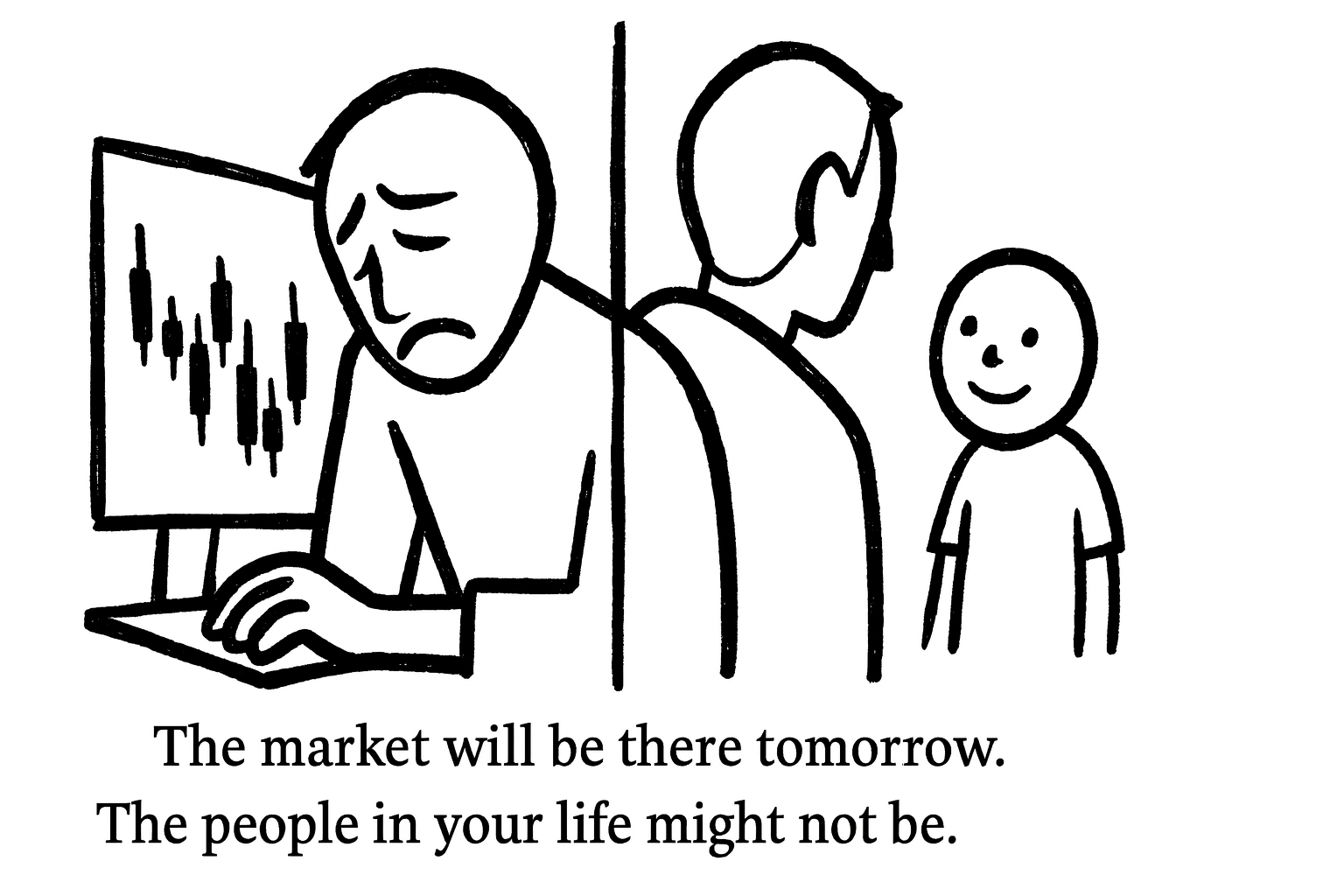
The market will be there tomorrow. The people in your life might not be.
Sometimes the biggest loss isn’t in your account — it’s in your home.
If you’re struggling, you have a choice to make. Keep chasing the dream until it costs you everything that matters, or step back and ask whether trading is really solving the problems you think it is.
The traders in these stories learned the hard way. You don’t have to.
What You Can Do Right Now
If this resonates, don’t just bookmark it and forget about it. Take action:
- Have the conversation you’ve been avoiding with your partner or family about your trading situation
- Set boundaries that protect your relationships more than your positions
- Consider whether you’re using trading to escape problems that need to be addressed directly
- Remember that seeking help isn’t failure — it’s risk management for your life
The goal isn’t to quit trading forever. It’s to trade in a way that builds your life instead of destroying it.
Because freedom isn’t just about money. It’s about being free to be fully present for the moments that actually matter.
If you found this helpful, you’re not alone in this struggle. The first step to recovery is admitting there’s a problem. The second step is to take action.


