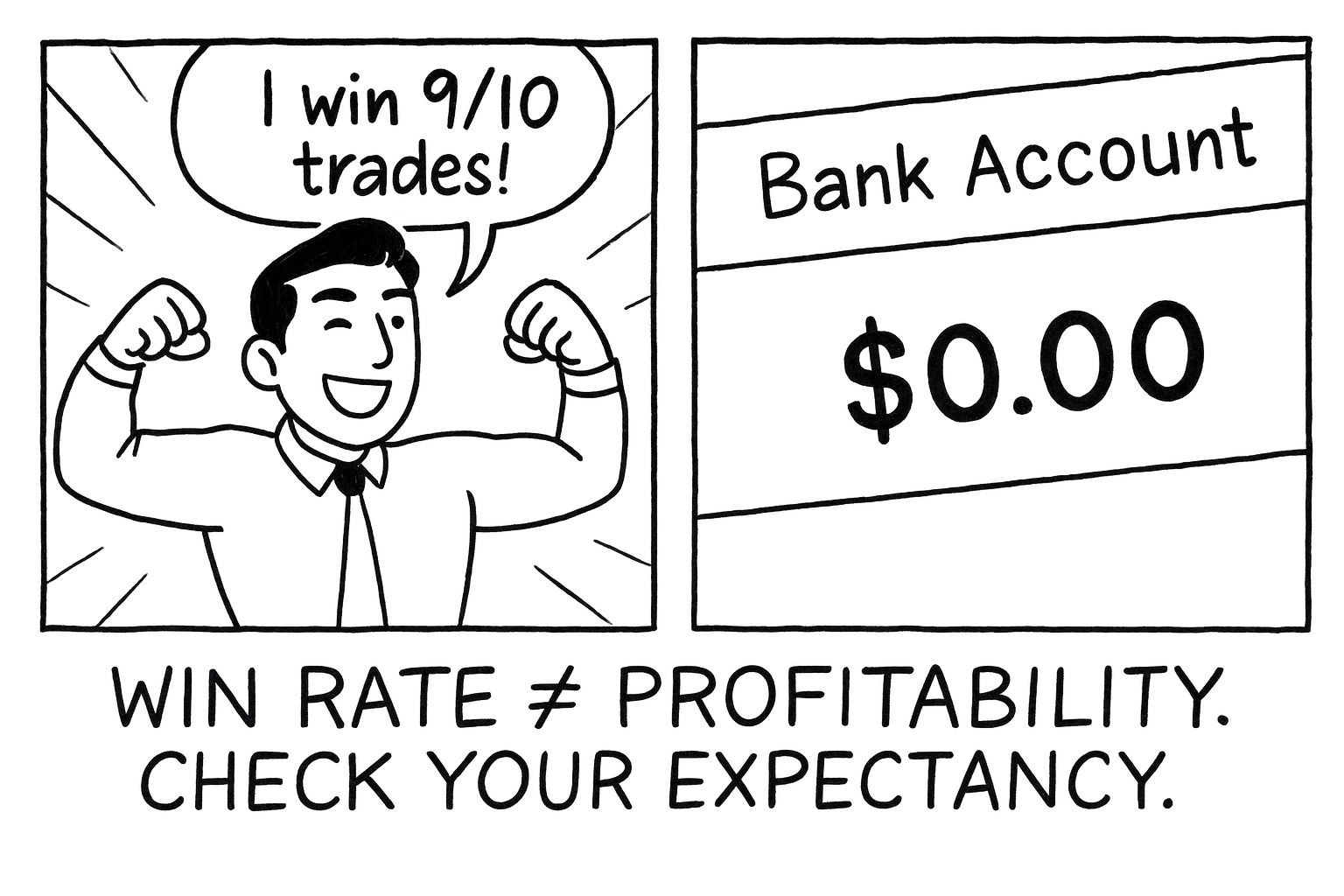
When traders ask how to measure the effectiveness of their strategy, what they’re really asking is: How much can I expect to earn (or lose) per trade with my system?
The answer lies in two powerful concepts that often get overlooked: Expected Value (EV) and Trading Expectancy.
Mastering these principles can help you identify whether your strategy has a real statistical edge — the difference between trading strategically and gambling blindly.
🔎 What is Expected Value (EV)?
Expected Value (EV) is the average amount of money you can expect to gain or lose per trade, given the probabilities of different outcomes.
It’s important to note that EV doesn’t predict the outcome of a single trade. Instead, it describes what you can expect over many trades.
For example, imagine you have a trading setup with:
- 70% chance of winning $100
- 30% chance of losing $100
The math works out as:
- Expected Win = 70% × $100 = $70
- Expected Loss = 30% × $100 = $30
- EV = $70 – $30 = $40
👉 On average, this system would return $40 per trade in the long run.
🎯 Why EV Matters
- Trading is probabilities, not certainties. No system wins every time.
- Positive EV = long-term edge. Even with losses along the way, consistent execution builds profitability.
- Negative EV = gambling. Without a positive edge, you’re fighting math — and the market always wins that battle.
📊 Introducing Trading Expectancy
While EV describes the probability-based expectation of a trade, Trading Expectancy measures the historical performance of your system.
Think of it as a way to evaluate how reliable your strategy really is based on your past trades (or backtesting).
It helps answer questions like:
- Which system is more profitable over time?
- Which system is more reliable or consistent?
- What times of day are most effective for my trading?
📐 The Formula for Trading Expectancy
The formula is simple:
Expectancy = (Win Rate × Average Win) – (Loss Rate × Average Loss)
Where:
- Win Rate = % of trades won
- Loss Rate = % of trades lost
- Average Win = average size of winning trades
- Average Loss = average size of losing trades
🧮 Example: Calculating Trading Expectancy
Suppose you made 10 trades:
- 6 winners (60% win rate)
- Total profit from winners = $1,200 → Average win = $200
- 4 losers → Average loss = $200
Now apply the formula:
- (60% × $200) – (40% × $200) = $120 – $80 = $40
👉 On average, you could expect to earn $40 per trade with this system.
🔍 Why Expectancy Is So Useful
- Compare systems: One system may have a higher win rate but smaller average wins. Another may win less often but deliver bigger wins. Expectancy shows which is superior in the long term.
- Spot hidden problems: If your real-world expectancy is much lower than your backtested expectancy, you may need to refine execution or adjust for external factors.
- Adapt strategies: By testing expectancy at different times of day or in different market conditions, you can identify when your edge is strongest.
🎲 EV vs. Expectancy
- EV: A probability-driven calculation applied to a trade setup.
- Expectancy: A historical, data-driven measure of your actual system’s performance.
Both work together to reveal the most important truth in trading:
👉 Without positive expectancy, profitability is impossible.
✅ Key Takeaways
- Positive EV = Long-term profitability. Focus less on winning every trade and more on stacking probabilities.
- Trading Expectancy = Reality check. Use it to evaluate your system’s historical performance and make adjustments.
- Think in series, not single trades. A single loss doesn’t matter if your system wins over hundreds of trades.
💡 Final Thoughts
Day trading is not about predicting every move — it’s about ensuring the math works in your favour over time.
If your strategy doesn’t have a positive expectancy, no amount of motivation or screen time will save it. However, if it does, then with discipline and consistency, the market becomes a game where the odds tilt in your favour.
👉 Action Step: Calculate your system’s expectancy today. Review your past 20–50 trades (or conduct a backtest if you don’t have sufficient data). Does your strategy have a positive expectancy? If not, it’s time to refine.
❓ Frequently Asked Questions (FAQ)
1. What is trading expectancy?
Trading expectancy is a formula that measures the average outcome of your trades based on your win rate, average win, and average loss. It tells you how much you can expect to earn or lose per trade over the long term, making it a key tool for evaluating the effectiveness of your trading strategy.
2. How do you calculate trading expectancy?
The formula is:
Expectancy = (Win Rate × Average Win) – (Loss Rate × Average Loss)
For example, if you win 60% of your trades with an average profit of $200 and lose 40% with an average loss of $200, your expectancy is:
(0.6 × $200) – (0.4 × $200) = $120 – $80 = $40 per trade.
3. What’s the difference between Expected Value (EV) and Trading Expectancy?
- Expected Value (EV): A probability-based concept that shows the potential average outcome of a given trade setup.
- Trading Expectancy: A historical performance metric based on your actual or backtested trades.
Both concepts aim to measure your statistical edge in the market.
4. Why is positive expectancy important in trading?
Without positive expectancy, no strategy can be profitable in the long run. A positive expectancy system ensures that, even with losses along the way, your winning trades generate enough profit to cover losses and yield net gains over time.
5. Can backtesting improve trading expectancy?
Yes. By applying the expectancy formula to backtested trades, you can measure how a system performs under historical conditions. Comparing backtesting results to real-world performance helps identify weaknesses, refine execution, and improve your trading results.
6. How many trades are needed to measure expectancy?
You can calculate expectancy with as few as a dozen trades, but the more trades you include, the more reliable the result. Ideally, use at least 20–50 trades for real insight, and combine this with backtesting for a larger data sample.
7. Does a high win rate always mean positive expectancy?
No. A system can have a high win rate but still produce a negative expectancy if the average losses are larger than the average wins. The key is to balance win rate and risk-reward ratio to ensure positive expectancy.